Quality problems in black polymer products rarely announce themselves clearly at the start. A PE pipe compound may pass routine inspections, meet the specified carbon black percentage, and look perfectly uniform to the naked eye. Yet months or years later, cracks appear, UV resistance weakens, or mechanical failure occurs unexpectedly. In many of these cases, the overlooked factor is dispersion rather than content. This is exactly where a carbon black dispersion analyzer becomes critical. At GT-TEST, as a professional supplier of polymer and plastic pipe testing equipment, we frequently encounter customers who realize too late that dispersion—not formulation—was the real issue behind field failures.
Carbon Black Dispersion in Plain English
Carbon black dispersion describes how evenly carbon black particles are distributed throughout a polymer matrix at the microscopic level. It is not about whether carbon black exists in the material, but whether it is broken down and spread uniformly during processing.
Dispersion vs. “Just Mixing Until It Looks Black”
Many production teams assume that once a compound looks uniformly black, dispersion must be acceptable. This assumption is risky. Carbon black has a natural tendency to form clusters during mixing and extrusion. These clusters can remain hidden beneath a visually smooth surface. From a quality standpoint, a material that looks homogeneous can still contain localized regions of poor dispersion that significantly weaken performance.
True dispersion means that carbon black particles are separated into fine structures and distributed evenly throughout the polymer. Poor dispersion means clusters survive the mixing process, creating internal inconsistencies that only become visible under microscopic examination.
What Dispersion Defects Look Like in Real Materials
In practice, dispersion defects appear as agglomerates, streaks, or window-like regions where carbon black concentration is lower than required. Agglomerates introduce stiffness variations and stress concentration points. Windows reduce UV shielding and expose the polymer to accelerated degradation. These defects do not always cause immediate failure, but they often determine how long a product survives in service.
What a Dispersion Analyzer Actually Measures
A carbon black dispersion analyzer transforms complex microscopic structures into quantitative data that engineers and quality managers can act on. Instead of relying on subjective judgment, it applies standardized optical and analytical methods to evaluate dispersion quality.
From Microscope Images to Meaningful Statistics
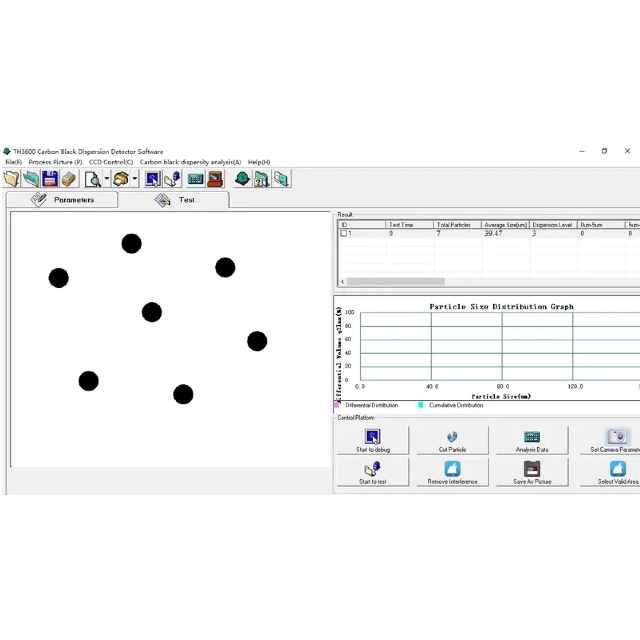
The process begins with a properly prepared specimen observed under controlled optical conditions. The analyzer captures detailed images of the polymer cross-section. Image analysis software then identifies carbon black particles and clusters, measuring their size, number, and spatial distribution.
This data reveals patterns that are impossible to detect visually. A small number of very large clusters often indicates insufficient shear during mixing. A broad distribution of medium-sized particles may suggest unstable processing conditions. These insights allow engineers to link dispersion results directly to production parameters.
Dispersion Grades as Decision-Friendly Results
To support consistent decision-making, dispersion results are often expressed as grades. A dispersion grade condenses complex image data into a standardized rating that can be easily interpreted across departments and organizations. For quality control teams, this simplifies acceptance decisions. For suppliers and customers, it provides a common language for discussing material quality without ambiguity.
Why Dispersion Matters in Real Products
Dispersion quality is not a laboratory curiosity; it directly affects how products perform in real-world applications, especially those exposed to stress, weather, and long service requirements.
Uniform Dispersion and Effective UV Protection
Carbon black is widely used to protect polymers from ultraviolet radiation. However, this protective function only works when carbon black is evenly distributed. Areas with insufficient carbon black allow UV light to penetrate deeper into the polymer, accelerating degradation. Over time, this leads to surface cracking, loss of flexibility, and reduced mechanical strength.
From Microscopic Defects to Macroscopic Failure
The progression from poor dispersion to failure follows a clear path. Dispersion defects create weak zones within the material. Under mechanical load, temperature fluctuations, or environmental exposure, these zones experience higher stress. Cracks tend to initiate at these points and propagate more rapidly through a non-uniform structure. For pressure pipes, cable jackets, and critical rubber components, this chain of events can shorten service life dramatically.
The Hidden Key: Sample Preparation Quality
Accurate dispersion analysis depends as much on specimen preparation as on the analyzer itself. Poor preparation can distort results and undermine confidence in the data.
Why Slice Thickness and Surface Quality Influence Results
Optical dispersion analysis relies on consistent light interaction with the specimen. Variations in slice thickness change how light passes through the material, affecting contrast and apparent particle size. Rough or damaged surfaces introduce artifacts that may be misinterpreted as dispersion defects. Consistent thickness and smooth surfaces are essential for reproducible results.
When a Microtome Becomes Essential
A microtome enables precise slicing of polymer specimens to a controlled thickness. This precision minimizes variability between samples and operators. In laboratories handling high testing volumes or working under strict standards, microtome-based preparation ensures that dispersion results reflect the material itself rather than preparation inconsistencies. GT-TEST supplies microtome solutions designed specifically for polymer dispersion testing, helping laboratories achieve reliable and repeatable outcomes.
A Quick Look at Modern Analyzer Capabilities
Modern carbon black dispersion analyzers are designed not only to measure dispersion, but also to fit seamlessly into daily laboratory workflows.
Automated Image Capture and Reporting
Automation is a key advantage of modern systems. Automated image capture and analysis reduce operator influence and improve repeatability. Results are compiled into structured reports that can be exported in widely used formats. This saves time, reduces manual errors, and ensures consistent documentation for internal reviews and external audits.
Optical Design and Image Analysis Workflow
Advanced optical configurations, including controlled illumination angles, enhance contrast between carbon black and the polymer matrix. Combined with optimized image analysis algorithms, these systems can detect subtle dispersion issues that manual inspection might miss. For laboratories supporting multiple production lines or customers, this level of sensitivity provides greater confidence in release decisions.
Where Dispersion Testing Fits into a Full QC Workflow
Dispersion testing delivers the most value when integrated into a comprehensive quality control strategy rather than treated as an isolated check.
Incoming Inspection, Process Control, and Final Verification
Dispersion analysis can be applied at multiple stages. Incoming material inspection verifies supplier consistency. In-process testing helps engineers adjust mixing and extrusion parameters before defects propagate. Final product verification provides documented evidence that finished goods meet performance expectations before shipment.
How Dispersion and Content Testing Work Together
Dispersion testing complements carbon black content testing. Content testing answers how much carbon black is present, while dispersion testing reveals how effectively it is distributed. Using both methods together provides a complete understanding of material quality and reduces the risk of hidden weaknesses reaching the field.
Typical Outputs from a Carbon Black Dispersion Analyzer
Output Item | What It Tells You | Why QC Teams Use It |
Dispersion grade | Standardized assessment of uniformity | Fast acceptance and release decisions |
Particle size distribution | Severity and nature of agglomeration | Process optimization and troubleshooting |
Image records | Visual proof of internal structure | Traceability, audits, and customer communication |
Why Dispersion Analysis Supports Long-Term Quality Control
Beyond immediate acceptance decisions, dispersion analysis supports long-term quality improvement. By tracking dispersion trends over time, manufacturers can identify gradual process drift before it results in failures. Historical image records provide valuable evidence during customer complaints or warranty discussions, helping resolve disputes based on data rather than assumptions.
For companies supplying infrastructure materials, such documentation is increasingly important. Customers expect not only compliant products but also transparent quality control processes. Dispersion analysis plays a key role in meeting these expectations.
Conclusion
For manufacturers of black PE pipes, rubber products, and polymer compounds, dispersion is a fundamental quality parameter that cannot be ignored. While carbon black content confirms formulation, dispersion determines real-world performance. A reliable carbon black dispersion testing system exposes hidden risks, supports informed process control, and strengthens confidence across the supply chain. GT-TEST, as a dedicated supplier of polymer testing equipment, provides integrated solutions that combine precise specimen preparation with advanced image-based dispersion analysis. If you are looking to improve product reliability and reduce long-term quality risks, contact us to learn how our dispersion testing solutions can support your laboratory and production needs.
FAQ
What does a carbon black dispersion analyzer evaluate?
It evaluates how evenly carbon black particles are distributed within a polymer, identifying clusters and non-uniform regions that affect performance.
Is dispersion testing necessary if carbon black content meets specifications?
Yes. Content testing confirms quantity, but dispersion testing reveals whether that carbon black is effectively distributed.
How does specimen preparation affect dispersion results?
Inconsistent thickness or surface quality can distort optical measurements. Proper preparation ensures accurate and repeatable analysis.
Which applications benefit most from dispersion analysis?
Applications with long service life or outdoor exposure, such as PE pipes and rubber components, benefit most from controlled dispersion quality.


