Thermal property testing forms the backbone of reliable polymer manufacturing. Without precise temperature thresholds, structural failures happen fast in field applications. We see rejected batches, compromised safety, and lost client trust when materials deform under stress. Operations need exact data to guarantee product integrity.
A Vicat tester serves as the foundational instrument for pinpointing exactly when a polymer loses its structural rigidity. Finding this exact softening point prevents costly production mistakes downstream. It acts as your primary defense against thermal-related material failures.
This guide explores how these testing units operate in modern laboratories. Quality control managers and procurement teams will discover how to evaluate and implement this essential equipment. You will learn to maximize testing efficiency while meeting strict industry regulations.
Key Takeaways
Vicat testing determines the softening point of polymers via needle penetration, critical for material formulation and safety verification.
Procurement should prioritize units that offer multi-station testing, rapid cooling mechanisms, and strict testing standards compliance (ISO 306, ASTM D1525).
Investing in combined laboratory HDT and Vicat softening temperature testing equipment provides the most comprehensive thermal analysis for evaluating new polymer compounds.
Equipment evaluation must balance upfront costs with long-term calibration stability, automation capabilities, and verifiable safety certifications (e.g., legitimate CE marking).
1. The Operational Value of Vicat Testing in Polymer Production
Unpredictable thermal behavior ruins extrusion runs. Injection molding requires exact heat parameters. Without them, scrap rates skyrocket. Companies face severe product liability risks when parts fail. Material deformation under heat causes immediate structural failure. Think about automotive dashboards facing intense solar radiation. They endure extreme heat inside sealed cabins. If the polymer softens too early, the dashboard warps permanently.
Identifying the Vicat Softening Temperature (VST) solves this problem. It gives you a clear threshold for safe usage. Engineers establish maximum continuous operating temperatures using this precise data. This validates the material for real-world stress conditions. Overall production risk drops significantly when you know exact thermal limits. You avoid shipping defective parts to demanding clients.
This test works best for specific plastics. Thermoplastics, PVC, polystyrene, and ABS show excellent results. Amorphous polymers lack a sharp melting point. They do not turn liquid instantly. Instead, they soften gradually as temperatures rise. Standard melting point analysis fails completely here. Vicat provides the exact surface penetration data needed. We rely on this test to qualify incoming raw materials quickly. You can easily spot degraded resin batches before they enter your molding machines.
Best Practices for Material Preparation
Condition samples in a controlled environment for 24 hours before testing.
Ensure specimen surfaces are perfectly flat and parallel.
Remove any flash or edge burrs from injection-molded samples.
2. Core Mechanics and Testing Standards Compliance
The mechanics remain beautifully straightforward yet highly precise. A flat-ended needle rests on your plastic specimen. It features a precise 1 mm² cross-section. The system applies a specific physical load to this needle. You usually select 10N or 50N weights based on material hardness. The heating bath temperature rises uniformly at a strict rate. The test concludes when the needle penetrates exactly 1 mm into the sample. The recorded bath temperature becomes your official Vicat Softening Temperature.
Industry bodies mandate strict testing methodologies. ASTM D1525 outlines the standard test method for plastics in North America. ISO 306 sets international rules globally. ISO 306 methods differ by applied load and heating rates. We organize these into four distinct testing categories. Lab managers must select the correct category for their specific polymer grade.
Table 1: ISO 306 Testing Methods Overview
Test Method
Applied Load (N)
Heating Rate (°C/h)
Method A50
10
50
Method B50
50
50
Method A120
10
120
Method B120
50
120
Manual heating control causes failed audits constantly. You need automated, PID-controlled heating rates. Strict testing standards compliance protects your laboratory from legal disputes. Verifiable data guarantees legitimate results for your clients. If your machine drifts from the required 50°C/hr rate, your data becomes invalid immediately. External auditors look for this exact flaw during facility inspections. High-end equipment uses digital microprocessors to keep the ramp rate perfectly linear.
3. HDT vs. Vicat: Maximizing Lab Utility
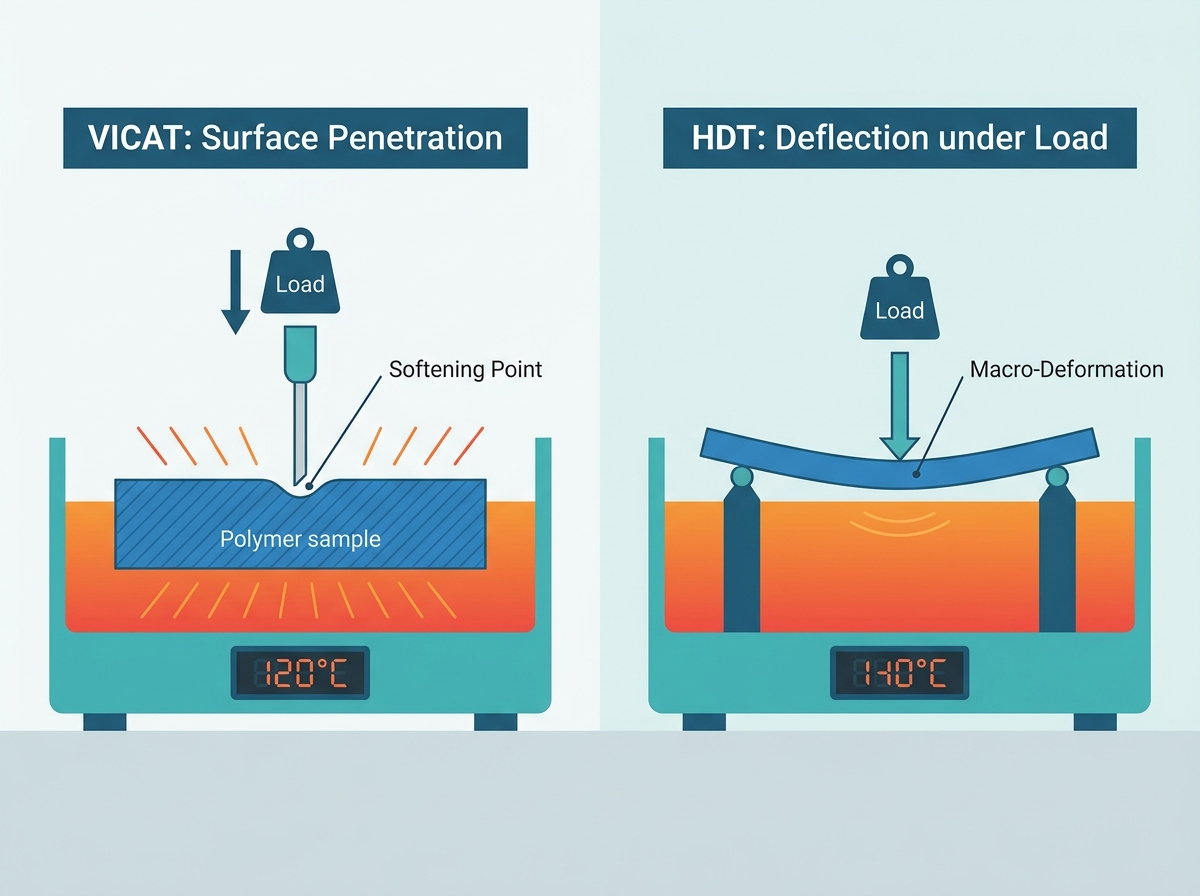
Let us clarify the technical difference between these two critical tests. Vicat measures surface penetration primarily. It tells us exactly when a polymer softens at a microscopic surface level. HDT (Heat Deflection Temperature) measures macro-deformation. It tells us when an entire material beam bends under a specific physical load. Engineers use HDT for structural load-bearing limits. They use Vicat for surface stability and extrusion profiling.
Table 2: Technical Comparison of HDT and Vicat
Feature
Vicat Testing
HDT Testing
Primary Measurement
Surface softening point
Macro-bending deflection
Indenter Type
Flat needle (1 mm²)
Loading edge (chisel)
Specimen Shape
Small flat plaque
Rectangular molded bar
Key Application
Extrusion and molding limits
Load-bearing structural limits
Modern labs avoid siloed machines. Buying separate units wastes money and space. Smart procurement teams buy combined units instead. A laboratory HDT and Vicat softening temperature testing equipment serves multiple roles seamlessly. The core heating bath remains identical for both tests. The displacement sensors operate the exact same way. You simply swap the testing heads depending on your daily needs.
Combined units save valuable floor space. They streamline technician training considerably. Operators learn one software interface instead of two. You achieve comprehensive mechanical-thermal profiling from a single batch of plastic. You gather both penetration and deflection data simultaneously in multi-station units. This drastically accelerates R&D cycles for new formulations.
4. Evaluation Criteria for Polymer Compound Testing Equipment
Evaluate your heating medium carefully before purchasing. Silicone oil baths remain the industry standard today. They offer excellent thermal stability across all stations. Oil-free systems use conductive metal blocks instead. They eliminate messy oil changes entirely. However, oil baths generally provide more uniform heat distribution for large multi-station setups. Consider automated water or pneumatic cooling mechanisms heavily. Rapid cooling reduces cycle times between tests. Faster cycles mean higher daily output for your lab.
Assess your station needs based on expected volume. Small testing labs might use 3 stations effectively. High-throughput QA centers often need 6 stations running constantly. Match the hardware strictly to your daily workload. Finding reliable polymer compound testing equipment requires balancing scale with budget constraints. Do not under-spec your station count if production is scaling up.
Microprocessor controls are mandatory for modern workflows. Automated weight application removes human operator error entirely. Technicians no longer drop heavy weights onto delicate samples. Motorized lifting systems lower the weights gently at the start of the test. LIMS (Laboratory Information Management System) integration keeps data secure. It pushes test results directly to your central servers automatically.
Vendor Vetting Guidelines
Avoid unverified, low-cost machines lacking brand history.
Look for robust build quality using stainless steel components.
Verify safety certifications like legitimate CE marking through third-party databases.
Ensure the vendor offers regional service agreements for fast repairs.
5. Implementation Risks and Workflow Integration
High-temperature testing creates distinct environmental challenges. Oil baths operating above 200°C pose burn hazards. Proper lab ventilation is absolutely vital. Silicone oil fumes require active exhaust hoods. You must vent these gases outside the workspace safely. Give your operators heavy-duty thermal gloves. Require safety goggles during sample retrieval. A safe laboratory prevents downtime and protects your workforce.
Do not ignore regular equipment calibration. Linear displacement sensors drift over time naturally. You must calibrate the LVDT (Linear Variable Differential Transformer) sensors annually at a minimum. Temperature probes need frequent checks against certified reference thermometers. The hidden maintenance expenses can add up if you neglect this schedule. Regular upkeep ensures your data remains legally defensible in client disputes.
Follow a logical framework for shortlisting new equipment vendors. First, request sample test reports from the manufacturer. Send them your actual polymer materials for a trial run. Second, verify their cycle-time claims using your specific polymer types. Third, audit the warranty terms closely for exclusions. Fourth, check the local availability of spare LVDT sensors in your region. Fast replacement parts keep your QA pipeline moving.
Common Mistakes to Avoid
Reusing degraded silicone oil, which causes uneven heating.
Failing to verify the needle tip diameter after long-term use.
Skipping the initial 5-minute pre-load phase required by ISO 306.
Conclusion
A high-quality testing unit acts as a frontline defense against material failure. It does far more than just tick a regulatory compliance box. You protect your brand reputation by verifying thermal limits before initiating mass production. Accurate softening data prevents catastrophic product recalls downstream.
Prioritize modularity and automation during procurement. Integrated testing systems serve growing labs best. They adapt to future material challenges easily. Features like pneumatic cooling and automatic weight placement generate massive workflow efficiencies. Your technicians can focus on data analysis rather than manual machine operation.
Consult an application engineer today. Spec out your exact station count and sensor requirements. Define cooling needs for your specific production line volume. Take decisive action to upgrade your thermal profiling capabilities before material failures impact your clients.
FAQ
Q: What is the difference between a polymer Vicat tester and a cement Vicat apparatus?
A: They share a similar name but serve different industries entirely. Cement testers measure setting time via penetration at room temperature according to ASTM C191. Polymer testers measure thermal softening under controlled heating. They use completely different equipment, load parameters, and environmental controls.
Q: How often should a Vicat tester be calibrated?
A: Industry best practice dictates annual calibration. Temperature sensors and displacement transducers require regular verification. High-throughput QA environments operating 24/7 often demand more frequent intervals. Consistent calibration ensures your test data remains legally defensible during audits.
Q: Can one machine test both HDT and Vicat?
A: Yes. Standardizing on a combined unit works perfectly for most labs. The core heating bath and displacement sensors remain identical for both tests. You simply swap the testing indenters and sample supports. This approach saves floor space and reduces overall equipment spending.