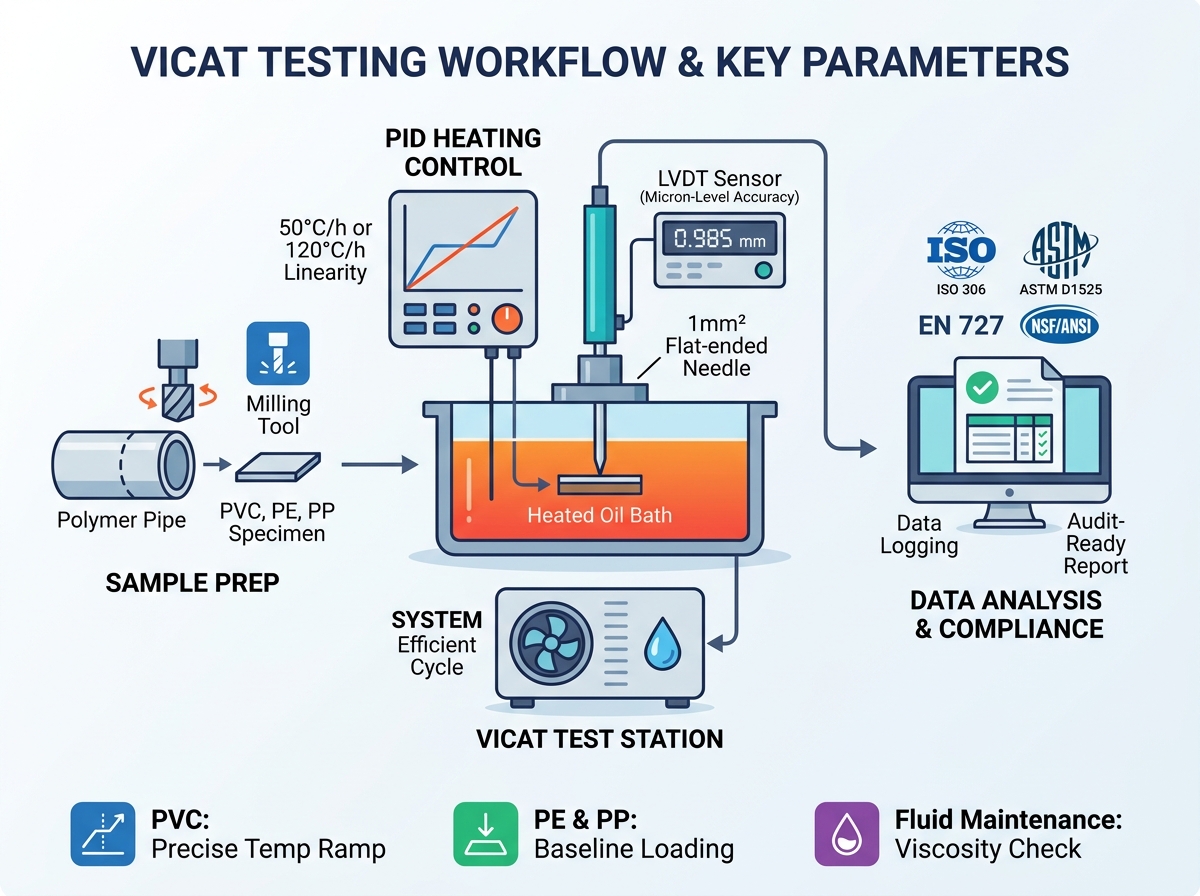
Thermal deformation failures in infrastructure piping lead to severe operational and compliance liabilities. Accurately determining the Vicat Softening Temperature (VST) is non-negotiable for polymer formulation and quality control. Transitioning from outsourced lab analysis to an in-house thermal testing workflow requires careful evaluation of equipment capabilities, compliance standards, and integration challenges. You cannot risk launching unverified pipe batches into active utility projects. Relying solely on external laboratories often creates severe production bottlenecks. Furthermore, it delays critical quality verifications right when you need them most. This guide provides a structured framework for evaluating and implementing an HDT/Vicat tester for plastics, specifically focusing on the unique thermal requirements of PVC, PE, and PP piping materials. You will discover practical strategies to integrate testing workflows, navigate complex global standards, and minimize costly measurement errors across your production floor.
Key Takeaways
VST data dictates maximum continuous operating temperatures for polymer pipes; inaccurate testing directly impacts NSF/ANSI certification.
Evaluating a testing system requires scrutinizing heating rate linearity, LVDT sensor resolution, and cooling cycle efficiency.
A comprehensive solution for PVC pipe testing machines must account for rigid material sample preparation and highly specific ISO/EN standards.
Minimizing human error in thermal testing relies on automated data logging and strict adherence to heat transfer fluid maintenance protocols.
The Financial and Operational Case for In-House Thermal Testing
Business Problem Framing
Delays in third-party testing constantly bottleneck production cycles for pipe extruders. You face significant operational risks when external labs take weeks to return your material data. High-speed extrusion lines produce kilometers of piping every single day. If you discover batch failures post-production, you generate massive amounts of costly scrap. We routinely see manufacturers lose thousands of dollars due to delayed thermal feedback. Bringing testing operations in-house solves this specific production problem directly. It keeps your data tight and your reaction times fast.
QA Integration
Implementing an in-house testing laboratory changes your entire quality assurance dynamic. It shifts thermal verification from a reactive audit to an active production control mechanism. You monitor formulation performance instantly. Your engineering team can pause extrusion lines the moment an anomaly appears. This proactive approach saves raw materials. It also prevents defective pipes from reaching your customers. Quality control becomes a continuous loop rather than an end-of-line hurdle.
Material-Specific Stakes
Different polymer matrices react uniquely to heat. You must understand these material-specific stakes to test them properly. Formulations behave differently under thermal load.
PVC: Unplasticized polyvinyl chloride is highly sensitive to its thermal history. It requires precise temperature ramp control during testing. You must avoid sudden heat spikes to prevent polymer degradation. If you heat PVC poorly, you compromise its structural matrix before the test even finishes.
PE and PP: Polyethylene and polypropylene feature complex semicrystalline structures. They require accurate baseline loading. You must apply the test weight perfectly to prevent premature penetration readings. Correct loading prevents false failure reports during strict compliance audits.
Common Mistake: Many lab technicians treat all plastics identically during testing. Applying identical pre-test soak times to both amorphous PVC and semicrystalline PP yields highly inaccurate penetration data.
Mapping Global Compliance Standards (ISO, EN, ASTM, NSF)
Standard Baseline
Purchasing decisions must map directly to laboratory certification requirements. You need test instruments that align perfectly with global infrastructure rules. We rely on strict core standards for pipe materials to ensure total field reliability. Non-compliant equipment generates useless data. It will fail third-party audits immediately.
Core Standards for Pipe Materials
Engineers follow specific guidelines to validate thermal integrity. You must program your machines to match these exact parameters.
EN 727 & ISO 306: These serve as the definitive standards for determining the Vicat softening temperature of thermoplastics. They are specifically critical for European pipeline compliance. You must master them to export products globally.
ASTM D1525: This standard outlines test methods for VST primarily in North America. It focuses heavily on constant load applications. It requires steady heating rates. Operators generally use 50°C/h or 120°C/h ramps.
NSF/ANSI Impacts: These standards heavily influence material ingredient testing. They dictate certification rules for potable water applications. VST data proves the pipes can handle continuous hot water exposure safely. It verifies that harmful chemicals will not leach at high temperatures.
Verification
Modern equipment must generate unalterable compliance reports automatically. These reports must map directly to specific ISO or ASTM clauses. You cannot rely on manual data transcription. Auditors look for secure, timestamped digital logs to verify your material claims.
Table 1: Global Compliance Standards Summary
Standard
Primary Region/Focus
Heating Rates
Key Application
EN 727
Europe
50°C/h
Specifically tailored for PVC pipe testing.
ISO 306
International
50°C/h or 120°C/h
General thermoplastics Vicat evaluation.
ASTM D1525
North America
50°C/h or 120°C/h
Standardized load testing for rigid plastics.
NSF/ANSI
Global Health
Varies by material
Potable water safety and chemical stability.
Core Evaluation Dimensions: Selecting an HDT/Vicat Tester for Plastics
Heating Control & Uniformity
Evaluating PID controller accuracy is absolutely crucial for your success. The standard requires strict linear heating throughout the entire cycle. Minor temperature fluctuations completely invalidate the test. You must guarantee a perfectly straight temperature curve. Advanced controllers use proactive algorithms to anticipate fluid heat capacity. They adjust power output dynamically to prevent sudden thermal overshoots.
Sensor Resolution
Assessing LVDT (Linear Variable Differential Transformer) transducers reveals the true capability of the machine. Look for genuine micron-level accuracy. We strongly recommend instruments capturing 0.001 mm displacement changes. This high precision detects the exact 1 mm penetration point without any ambiguity. Subpar sensors introduce mechanical noise. This noise obscures the precise moment the polymer matrix yields.
Station Configurations
Balancing capital expenditure with laboratory throughput influences your station configurations. Multi-station models allow simultaneous testing of entirely different batches. Options typically range from three to six independent testing stations. They give you the flexibility to handle high production volumes. We suggest buying more stations than you currently need. This allows room for future production capacity scaling.
Cooling Infrastructure
Cooling infrastructure represents a hidden bottleneck in many modern labs. You must assess the efficiency of water or chiller-assisted cooling systems carefully. Faster return-to-ambient temperatures drastically increase your daily test volume. You do not want operators waiting multiple hours between testing cycles. High-capacity external chillers drop oil temperatures rapidly. This upgrade pays for itself through increased daily throughput.
Best Practice: Always integrate a closed-loop refrigerated chiller system if you test more than three batches daily. Relying on ambient tap water for cooling limits production speed drastically in warmer climates.
Integrating a Complete Solution for PVC and PP Pipe Testing Machines
Workflow Alignment
A tester does not operate in a vacuum. It must integrate smoothly with upstream sample preparation. It also needs seamless downstream data management. Proper workflow alignment ensures consistent daily operations. You must view the thermal tester as one cog in a larger validation machine. If sample preparation fails, the most accurate tester will still yield bad data.
Sample Preparation Requisites
Standardized cutting and milling tools remain strictly required. You must achieve exact specimen dimensions consistently. Samples need perfectly flat and parallel surfaces. You must prepare them without introducing internal mechanical stress. Rough cutting with a bandsaw creates friction heat. This pre-stresses the plastic and ruins your baseline thermal history.
Tailoring to the Material
The optimal solution for PVC pipe testing machines requires dedicated ventilation considerations. You face potential toxic off-gassing at very high testing temperatures. Implementing localized fume extraction protects your lab personnel. Rigid sample mounting protocols are also essential. PVC samples can warp under preliminary stress if mounted incorrectly.
Conversely, a dedicated solution for PP pipe testing machines demands highly specific load weight configurations. You typically adapt 10N or 50N weights to match varying polyolefin characteristics. Semicrystalline materials deform differently than amorphous ones. You must calibrate the test weights specifically for PP grades to avoid puncturing the sample too early in the heat cycle.
Automation
Automation protects operator safety directly. Moving from manual weight application to automated lowering mechanisms makes a huge difference. Pneumatic or motorized systems ensure consistent load application every single time. They remove operator variability completely. Automated systems also prevent hot silicone oil splashes. This creates a vastly safer working environment for your technicians.
Addressing the temperature differential between the bath fluid and the polymer specimen core is critical. Thermal lag causes massive heat transfer inefficiencies. You must allow sufficient soak time before starting the temperature ramp. If the oil heats faster than the plastic interior, you record artificially high softening points. This leads to dangerous material approvals.
Fluid Degradation
Silicone oil viscosity changes over time at high temperatures. Fluid degradation ruins heat transfer uniformity across your testing bath. We recommend establishing a strict operational baseline for fluid replacement. Dark, oxidized oil heats unevenly. It creates localized hot spots near the heating elements. You should track operating hours diligently to schedule routine fluid changes.
Equipment Calibration
Routine third-party calibration remains a strict necessity for all labs. You must calibrate your temperature sensors and LVDTs regularly. This practice maintains continuous ISO audit readiness. It guarantees your test data stands up to intense external scrutiny. Always use certified reference materials to verify machine accuracy between official calibration cycles.
Selecting the Right Test Needle
Ensuring the 1 mm² flat-ended test needle is pristine prevents major mechanical errors. Select the right needle and inspect it routinely under magnification. It must remain free of micro-abrasions. Scratches alter penetration friction and distort your final results. A damaged needle drags against the softening polymer. This creates artificial resistance and ruins the test.
Common Mistake: Technicians often wipe hot test needles with abrasive cloths. This introduces microscopic scratches on the 1 mm² contact face. Always use non-abrasive, solvent-soaked wipes for cleaning.
Shortlisting Logic & Next Steps
Vendor Scrutiny
Prioritize manufacturers who provide comprehensive Factory Acceptance Testing (FAT). You also need highly transparent LVDT calibration certificates. Vendor scrutiny separates adequate machines from exceptional laboratory instruments. Ask vendors to explain their PID tuning algorithms. Request detailed schematics of their fluid circulation pumps. Superior agitation systems guarantee the strict temperature uniformity required by EN 727.
Actionable Step
Request a physical demonstration using your specific PVC or PP extruded samples. You should verify heating linearity directly during this trial. Ask the vendor to show you automated report generation against EN 727 standards. Seeing the machine test your actual product proves its real-world value. Do not rely entirely on generic marketing brochures. Demand raw data exports from your sample trials to evaluate their software capabilities thoroughly.
Conclusion
Validating polymer pipe durability requires much more than basic thermal checks. It demands standard-compliant, precisely controlled Vicat testing protocols. Investing in a high-accuracy HDT/Vicat tester for PVC pipe testing and polyolefins protects your brand fundamentally. It acts as an active investment in operational risk mitigation. You prevent catastrophic field failures entirely. You also ensure continuous regulatory market access for your extruded products.
To move forward effectively, consider these next steps:
Audit your current thermal testing workflow immediately to identify specific automation gaps.
Demand proven LVDT sensor resolutions of at least 0.001 mm from potential equipment suppliers.
Verify vendor software capabilities for unalterable, audit-ready compliance reporting.
Implement strict, calendar-based maintenance schedules for heat transfer fluid replacement.
FAQ
Q: What is the difference between HDT and Vicat testing for polymer pipes?
A: HDT measures the temperature at which a polymer specimen bends or deflects under a specific load. Vicat testing measures the exact surface softening point where a flat-ended needle penetrates the material by 1 mm. Both provide crucial but distinct data points for evaluating structural integrity.
Q: Why is EN 727 specific to PVC pipe testing?
A: EN 727 outlines highly specific sample preparation and testing parameters tailored exclusively to unplasticized PVC (UPVC). It addresses the unique thermal properties, rapid degradation risks, and stringent safety standards required for European PVC infrastructure piping.
Q: How often should the heat transfer fluid in a Vicat tester be replaced?
A: You should replace the silicone oil every 6 to 12 months, depending on test volume. However, you must replace it immediately if you observe visible discoloration, increased viscosity, or a noticeable drop in heat transfer uniformity during calibration checks.
Q: Can one machine handle both PVC and PP pipe testing?
A: Yes. A single machine handles both materials provided it supports interchangeable test weights (10N and 50N). It must also feature highly programmable heating rates (50°C/h and 120°C/h) to meet the respective standard for each unique polymer type.