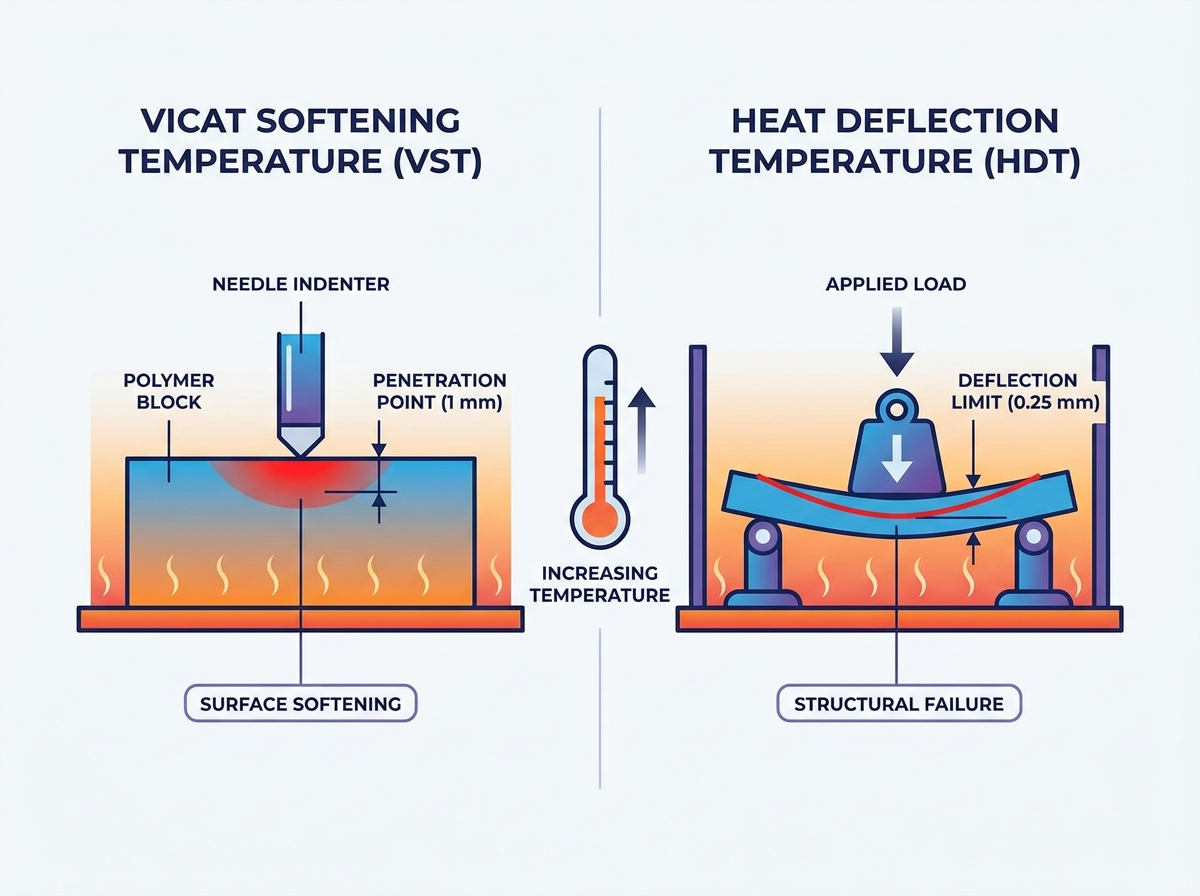
In polymer characterization, thermal resistance acts as a primary quality and safety indicator. Components must survive heat exposure without losing their intended physical properties. Yet, lab managers and design engineers often blur the lines between surface softening metrics and bulk structural limits. Relying on an incorrect thermal metric brings severe consequences. It can lead to catastrophic material failure once a product reaches the market. Conversely, it triggers unnecessary batch rejections during routine quality control checks. We aim to clarify the distinct physical phenomena measured by Vicat and HDT. You will learn about the exact ASTM and ISO standards dictating these tests. Furthermore, we outline a practical framework for evaluating laboratory equipment to ensure accurate thermal profiling and robust material compliance.
Key Takeaways
Vicat Softening Temperature (VST) measures the temperature at which a polymer’s surface loses its hardness and is penetrated by a needle.
Heat Deflection Temperature (HDT) measures the temperature at which a polymer sample deforms under a specific applied load, indicating structural failure.
A combined HDT and Vicat tester streamlines thermal testing by allowing simultaneous assessment of both parameters under identical heating rates.
Integrating these results with data from a differential scanning calorimeter (Tg/Tm) and a melt flow indexer provides a complete picture of a polymer’s thermal and rheological profile.
Fundamental Definitions: What Are We Actually Measuring?
Understanding thermal limits requires precise definitions. You cannot predict material behavior without knowing exactly what physical changes occur during heating. Both Vicat and HDT evaluate thermal resistance. However, they observe completely different mechanical failures.
Vicat Softening Temperature (VST) – The Penetration Point
The Vicat test identifies the exact moment a material surface yields to localized pressure. The mechanism relies on a flat-ended needle. This needle features a precisely machined 1 mm² circular cross-section. The apparatus places this indenter on the specimen surface under a specific load. As the temperature rises, polymer chains gain mobility. The system records the temperature exactly when the needle penetrates the specimen to a depth of 1 mm.
Major testing frameworks strictly govern this procedure. You will typically test according to ISO 306 or ASTM D1525 standards. These documents dictate load options, usually 10N or 50N, and standardize heating rates.
This metric holds immense significance for material scientists. It pinpoints the onset of surface softening. You will find it closely correlates to the polymer’s melting point or glass transition phase. However, a common mistake occurs here. Many engineers assume a high Vicat value equals high structural strength. This is false. VST simply indicates surface hardness retention. It never represents bulk load-bearing capability under stress.
Heat Deflection Temperature (HDT) – The Load-Bearing Limit
HDT measures true structural endurance. It identifies the temperature at which a material bends under a sustained force. The mechanism uses a standard rectangular test bar. The apparatus places this bar on two supports, forming a three-point bending setup. A central loading wedge applies a specific flexural stress. Standard tests typically use 0.45 MPa for softer plastics or 1.80 MPa for rigid polymers. The machine records the temperature when the bar deflects by a specified distance, commonly 0.25 mm.
Standardization ensures global comparability. Laboratories follow ISO 75 or ASTM D648 for HDT testing. These frameworks detail precise specimen dimensions and stress calculations.
The significance of HDT directly impacts product design. It defines the maximum safe operating temperature for parts subjected to structural stress. If an automotive bracket must hold an engine component, you evaluate its HDT. This metric warns you when the macro-structure will warp, fail, or collapse in real-world environments.
HDT vs. Vicat: Core Testing Parameters Compared
Choosing the right test requires understanding the mechanical differences in the laboratory setup. While both tests evaluate thermal degradation, their input variables diverge significantly. Let us examine the core parameters that separate these two methodologies.
Table: Quick Comparison of HDT and Vicat Test Parameters
Requires precisely molded or machined rectangular bars
The indenter geometry creates fundamentally different stress fields. The flat needle in the Vicat test forces polymer chains to move aside locally. Conversely, the wedge edge in the HDT test places the entire lower half of the specimen in tension and the upper half in compression.
Applied load mechanics also vary. Vicat uses fixed weights regardless of sample thickness. HDT requires precise calculations. You must measure the exact width and depth of the HDT bar to determine the proper weights needed to achieve 0.45 MPa or 1.8 MPa of flexural stress.
Both tests share standardized heating rates. You generally select either 50°C/hour or 120°C/hour. This shared parameter necessitates highly precise temperature control within the heating bath. Temperature uniformity prevents localized hot spots from skewing the penetration or deflection data.
Specimen preparation dictates lab workflow speed. Vicat allows for smaller, simpler geometries. You can often test cut plaques or small molded buttons. HDT demands rigorous preparation. You must injection-mold or carefully machine rectangular bars to exact dimensional tolerances. Any dimensional variance directly alters the applied flexural stress, invalidating the test.
Practical Applications: When to Rely on Which Data Set
Data without context leads to engineering failures. Knowing when to apply Vicat data versus HDT data separates successful designs from costly recalls. Each test serves distinct phases of manufacturing and engineering.
When to Use Vicat
Vicat data provides rapid, actionable insights for material handling and surface interactions. You should rely on VST in the following scenarios:
Quality control of incoming raw materials: VST requires minimal sample preparation. Lab technicians can quickly melt a sample button and verify batch consistency before full production begins.
Evaluating surface applications: Use VST for parts involving friction or surface contact. Gears, protective housings, and sliding tracks must resist localized surface melting. VST tells you exactly when that surface integrity fails.
Comparing polymer grades: When selecting between different grades of ABS or Polycarbonate, VST offers a quick baseline. It allows you to rank materials based on relative heat-softening properties without molding complex structural bars.
When to Use HDT
HDT data forms the backbone of structural safety. It simulates macro-level physical demands. You must rely on HDT for these critical engineering tasks:
End-use product design: Structural engineering requires HDT. If a polymer serves as a load-bearing chassis, you must know when it will bend under operating temperatures.
High-stress environment evaluation: Automotive under-hood components and structural piping face continuous heat and pressure. HDT defines the absolute upper thermal limit for these specific geometries.
Validating composite materials: Adding glass or carbon fibers restricts polymer chain mobility. This reinforcement drastically improves structural heat resistance. HDT accurately quantifies this improvement in glass-fiber reinforced polymers, whereas VST often fails to capture the macro-structural benefit of the fibers.
Evaluating a High Precision HDT/Vicat Tester for Your Lab
Modern laboratories rarely purchase standalone machines for these tests. The workflow overlaps too heavily. Instead, procurement focuses on combined systems. An integrated HDT and Vicat tester maximizes space efficiency. It uses shared heating baths and unified software reporting, streamlining technician training and daily operations.
When upgrading your facility, you must evaluate equipment across several stringent dimensions. A poor testing apparatus yields useless data.
Heating Medium and Cooling Efficiency
The thermal bath dictates test accuracy and cycle time. Historically, labs used standard oil-based systems. Today, you should look for environmentally friendly silicone oils. Silicone oil resists thermal degradation at higher temperatures, extending maintenance intervals. Alternatively, advanced labs utilize aluminum oxide fluidized bed systems. These dry mediums eliminate oil fumes, reduce burn hazards, and make specimen retrieval incredibly clean.
Cooling mechanisms are equally critical. A test might take two hours to run, but if the bath takes four hours to cool, your daily throughput collapses. Look for systems featuring integrated water cooling coils or active heat exchangers. Rapid cooling allows technicians to run multiple batches within a single shift.
Measurement Precision
Accuracy separates adequate labs from elite facilities. You must seek out a high precision HDT/Vicat tester equipped with advanced sensor technology. Avoid older dial gauges. Specify LVDT (Linear Variable Differential Transformer) displacement sensors. LVDTs provide continuous, micro-level deflection accuracy. They detect the exact moment a specimen hits the 0.25 mm deflection or 1.0 mm penetration mark without mechanical lag.
Station Scalability
Match the hardware to your production volume. Testing systems range widely in capacity. A low-volume R&D lab might only need a 2-station configuration. However, high-output quality control facilities require 4-station or 6-station models. Multi-station systems allow you to test various materials simultaneously or run large batch averages in a single heating cycle. Evaluate your weekly testing volume before committing to a specific station count.
Automation and Compliance
Human error ruins thermal data. Automation removes this risk. Modern testers feature motorized weight lowering and lifting mechanisms. This protects operators from splashing hot oil and ensures weights apply smoothly without sudden impact stress on the specimen.
Furthermore, automated deflection zeroing guarantees every test starts from a perfect baseline. Finally, examine the software. It must natively output ISO and ASTM compliant reports. Look for tamper-proof data logging. This proves crucial during external audits or client quality disputes.
Complementary Thermal Analysis: Building a Comprehensive QA Workflow
Relying solely on physical deflection tests creates a dangerous blind spot. HDT and Vicat alone aren't enough for total material characterization. They tell you *when* a material fails mechanically, but they do not explain *why* it fails at a molecular level. Building a robust QA workflow requires bridging these data gaps with complementary instruments.
Thermal Phase Transitions
You cannot fully understand a Vicat result without knowing the polymer's thermal phase transitions. Cross-referencing physical data with molecular data prevents false assumptions about material stability.
To achieve this, laboratories run samples through a differential scanning calorimeter. This instrument measures the exact heat flow into or out of a material as temperature changes. It clearly identifies the Glass Transition Temperature (Tg) and the Melting Peak (Tm).
When you compare DSC data against Vicat results, patterns emerge. You might discover a polymer softens right at its Tg, or it might maintain hardness until it approaches its Tm. Without a differential scanning calorimeter, you are merely guessing at the underlying thermodynamic causes of your mechanical failures.
Processability Evaluation
Thermal resistance limits matter little if you cannot mold the material properly. Sometimes, poor HDT results stem from polymer degradation during the injection molding of the test bar itself.
You must evaluate processability prior to thermal testing. Pairing your deflection data with rheological data from a melt flow indexer ensures structural integrity. A melt flow indexer measures the rate of extrusion of molten resins. If an incoming batch shows an unusually high melt flow rate, it indicates shortened polymer chains. These degraded chains will inevitably perform poorly in an HDT test.
By screening materials with a melt flow indexer first, you ensure the resin can actually be molded without degradation. This multi-instrument approach guarantees that your HDT and Vicat failures reflect the true nature of the formulation, not a processing error.
Conclusion
Mastering polymer characterization requires separating surface phenomena from structural reality. Vicat testing accurately defines surface integrity and local softening behavior. It serves as an excellent, rapid indicator for material consistency. HDT strictly defines structural viability. It dictates the true operating limits for load-bearing designs in demanding environments. Confusing the two compromises both safety and product functionality.
To modernize your material testing capabilities, take immediate action. First, audit your current and projected testing volume to determine required station capacity. Next, evaluate your specific compliance requirements, verifying whether your clients demand ISO or ASTM adherence. Finally, request technical specification sheets or live demonstrations for integrated HDT/Vicat systems. Upgrading to automated, high-precision equipment ensures your lab delivers unquestionable thermal data for every batch.
FAQ
Q: Can I calculate or estimate HDT from Vicat results?
A: No. While they sometimes trend together in unreinforced amorphous polymers, crystalline polymers and fiber-reinforced plastics will show completely divergent relationships. They measure fundamentally different physical properties.
Q: How does Glass Transition Temperature (Tg) relate to HDT and Vicat?
A: For amorphous polymers, Vicat and HDT often fall close to the Tg. For semi-crystalline polymers, HDT is highly dependent on the applied load and the degree of crystallinity, often falling significantly below the melting temperature but above the Tg.
Q: Why does my HDT value change so drastically when I change the load from 0.45 MPa to 1.8 MPa?
A: Higher stress forces the polymer chains to yield at lower temperatures. A steep drop-off at higher loads usually indicates a material with low structural rigidity at elevated temperatures, despite a high melting point.