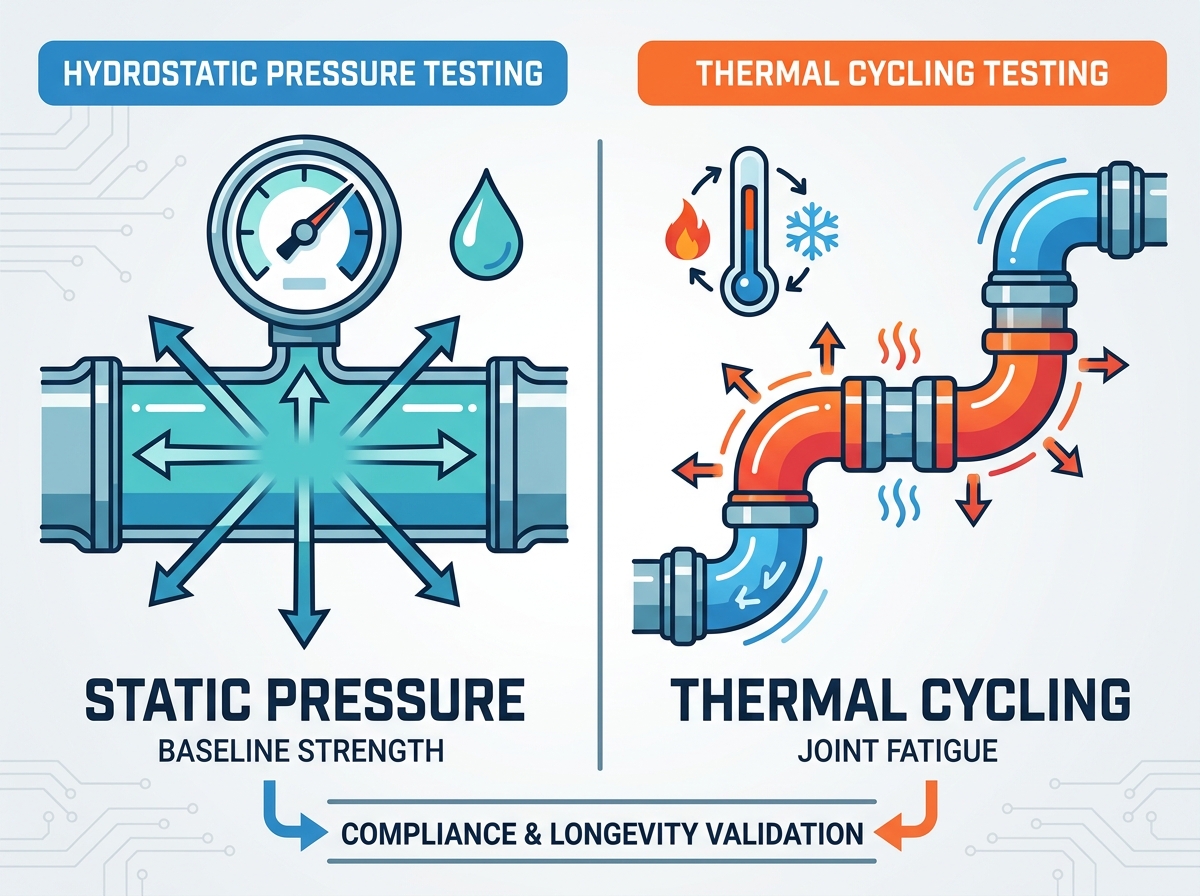
Validating the service life of plumbing systems requires more than standard burst tests. For hot and cold water pipes like PEX, PPR, and CPVC, manufacturers and QA labs must prove joint integrity and material longevity under continuous stress. Failing to account for environmental factors can lead to catastrophic leaks and premature system degradation. In this article, we compare the distinct roles of static internal pressure checks versus dynamic temperature fluctuation simulations. We provide QA engineers and procurement managers with a clear framework to evaluate testing methodologies. You will understand compliance standards like ISO and ASTM to better select the right testing equipment for your specific facility requirements.
Key Takeaways
Hydrostatic testing establishes the baseline mechanical strength and leak resistance of pipes under constant internal pressure.
Thermal cycling simulates decades of real-world use by stressing the pipe material and joints through rapid expansion and contraction.
Procuring a thermal cycling tester is essential for certifying hot water plumbing components, whereas a hydrostatic pressure tester is the mandatory baseline for all pressurized piping.
Full compliance for PP pipe testing equipment typically requires deploying both methods to satisfy international safety and quality standards.
The Engineering Challenge: Why Pressure and Temperature Diverge in Pipe Testing
Thermoplastic materials react uniquely to environmental stress. Polypropylene (PP) and cross-linked polyethylene (PEX) expand significantly when heated. They subsequently contract when cooled. Applying steady static pressure causes a steady outward hoop stress on the polymer chains. Conversely, dynamic temperature shifts cause cyclical linear expansion and contraction. These two distinct physical forces create entirely different failure modes in piping systems.
A constant internal pressure often leads to creep rupture over an extended period. The material slowly deforms until the pipe wall fails. In contrast, fluctuating temperatures typically cause mechanical fatigue. This fatigue concentrates heavily at mechanical joints, fusion welds, and metallic transition fittings. Industry standards recognize these divergent physical realities. ISO 15874 dictates specific baseline parameters for PP pipes. ASTM F2389 outlines rigorous requirements for pressure-rated polypropylene piping systems.
Regulators deliberately mandate distinct tests because a single model cannot capture all failure risks. Testing purely for hydrostatic burst strength completely ignores the creeping degradation caused by decades of hot water usage. You need specific testing hardware to simulate each condition accurately.
Hydrostatic Pressure Testing: Baseline Burst and Yield Integrity
This core methodology applies continuous internal fluid pressure to a pipe specimen. Operators maintain this pressure at a stable ambient or elevated temperature. The test runs continuously until the material yields or for a strictly specified duration. The standard 24-hour test remains a common industry baseline for quick batch release.
Using a robust hydrostatic pressure tester verifies several critical pipe attributes. It checks wall thickness consistency and overall material formulation. It uncovers initial manufacturing defects quickly before products leave the factory. Long-term testing regimens assess the long-term hydrostatic strength (LTHS). Engineers extrapolate these data points to verify the minimum required strength (MRS) over a 50-year lifespan.
Laboratories face several operational realities during implementation. Managing pressure drop variations requires highly precise pump control and specialized accumulator systems. Safety protocols remain non-negotiable for operator protection. High-pressure water containment is vastly safer than pneumatic testing alternatives. Air compresses heavily under load, making unexpected blowouts extremely explosive. Water is largely incompressible. This fundamental physical trait limits explosive force significantly if a pipe bursts.
You must also account for ambient cold temperatures during winter testing. Cold environments artificially harden thermoplastics. You need specific temperature compensation formulas to ensure accurate compliance data.
Essential Hydrostatic Testing Best Practices
Always bleed trapped air from the specimen before pressurizing the system.
Calibrate pressure transducers quarterly to prevent false compliance readings.
Apply standard temperature compensation formulas when testing in unconditioned spaces.
Use precision end-caps to prevent unnatural stress concentrations at the pipe ends.
Thermal Cycling Testing: Simulating Lifespan and Joint Fatigue
Real-world plumbing systems rarely experience steady static conditions. They endure constant temperature shifts throughout their service life. This methodology subjects the piping assembly to alternating cycles. We push hot and cold water through the test pipes under continuous operating pressure. Compliance tests often span 5,000 to 10,000 continuous cycles depending on the standard.
A high-quality thermal cycling tester proves the integrity of complex mechanical fittings. It effectively validates fusion welds and integrated brass valves. Linear expansion and contraction constantly push and pull at these specific joints. The equipment evaluates the resulting fatigue resistance perfectly.
Implementation brings specific challenges for facility managers. Energy consumption remains a major operational factor. The heating and cooling units require significant industrial power to operate continuously. The physical footprint of these thermodynamic units is quite large. Transition time accuracy is perhaps the most critical compliance metric. Standards dictate the exact speed at which water changes from hot to cold.
For instance, dropping fluid temperature from 90°C to 20°C might require a transition under 60 seconds. If transition tolerances fail, the entire test batch becomes invalid. Long-duration automated tests demand strict system maintenance. Flow sensor calibration ensures data remains entirely reliable over multi-week automated runs.
Head-to-Head Comparison: Selecting Your PP Pipe Testing Equipment
When building a modern QA laboratory, you need clear evaluation dimensions. Procurement managers must balance equipment capabilities against strict compliance requirements. Comprehensive PP pipe testing equipment setups usually require deploying both testing methodologies.
Evaluation Matrix: Methodology Comparison
Evaluation Dimension
Hydrostatic Pressure Testing
Thermal Cycling Testing
Primary Objective
Static yield strength and LTHS validation
Dynamic joint fatigue and real-world lifespan
Test Duration
Short to medium-term hold times (hours to days)
Multi-week continuous cycling (weeks to months)
Capital Expenditure
Standard pressure pumps and manifolds (Moderate)
Complex thermodynamic rigs with chillers (High)
Footprint & Infrastructure
Minimal floor space, standard laboratory drainage
Large footprint, heavy water and power supply needs
Laboratories rarely choose one methodology over the other. Relying on a single testing method leaves massive compliance gaps. You must build tiered testing environments to ensure total quality control. A standard production pipeline validates baseline burst strength first. The same material batch then moves to dynamic temperature fluctuation testing. This sensible logic satisfies complete international safety suites.
EHS (Environment, Health, and Safety) and Operational SOPs
High-pressure testing machinery poses inherent physical risks to technicians. Robust Environment, Health, and Safety (EHS) protocols protect laboratory personnel effectively. Safety checklists serve as your fundamental baseline. We strongly recommend isolating test bays using impact-resistant physical barriers. Never substitute compressed air for water during burst checks. Water remains relatively safe when highly pressurized due to its incompressibility.
Calibration and auditing form the next critical EHS pillar. You must perform routine maintenance to ensure test validity. Failing to calibrate temperature and pressure sensors leads to dangerous false passes. Document every audit trail carefully for compliance regulators. Operator training varies significantly between different testing machines.
Hydrostatic operators focus heavily on pressure ramp rates, end-cap sealing, and visual leak detection.
Cycling operators must understand fluid thermodynamics, flow rates, and transition timing tolerances.
Both laboratory teams require emergency shut-off drill training at least quarterly.
Hydrostatic pressure testing proves the pipe can safely hold the designated mechanical load. Thermal cycling proves the entire plumbing system will survive its harsh operating environment. Both methodologies form the vital backbone of a reliable quality assurance program. Deploying them together ensures your products will perform flawlessly for decades.
Next-Step Actions:
Review your current ISO and ASTM compliance mandates thoroughly before initiating any new procurement.
Request granular transition time data when evaluating complex thermal tester specifications from vendors.
Verify pressure stability tolerances and transducer accuracy specifically for your hydrostatic models.
Assess your laboratory infrastructure early to ensure adequate electrical power and fluid drainage capacities.
FAQ
Q: How does temperature affect hydrostatic test pressure results?
A: Thermoplastics have an inverse relationship between temperature and pressure resistance. As ambient or fluid temperatures rise, the material softens. This softening lowers the pipe's internal yield strength. To maintain accurate testing data, operators must use strict temperature compensation formulas or test inside climate-controlled environments.
Q: Is a 24-hour hydrostatic test strictly necessary for PP pipes?
A: Yes, it is typically the minimum baseline required by most international standards. While shorter burst tests can identify gross manufacturing defects, a 24-hour test proves early-stage creep resistance. Assessing long-term hydrostatic strength (LTHS) requires even longer durations to plot accurate failure curves.
Q: Can a thermal cycling tester replace hydrostatic burst tests?
A: No, these machines test completely different failure mechanisms. A cycling machine evaluates fatigue caused by expansion and contraction over time, especially at joints. Burst tests evaluate raw material strength and wall thickness integrity under static load. One method cannot replace the other for complete compliance.
Q: What are the safety differences between pneumatic and hydrostatic testing?
A: Hydrostatic testing uses water, which is practically incompressible. If a pipe bursts, the pressure dissipates immediately with minimal explosive force. Pneumatic testing uses compressed air, which stores massive potential energy. A failure under pneumatic load causes a dangerous explosion, making it highly discouraged for plastic pipes.