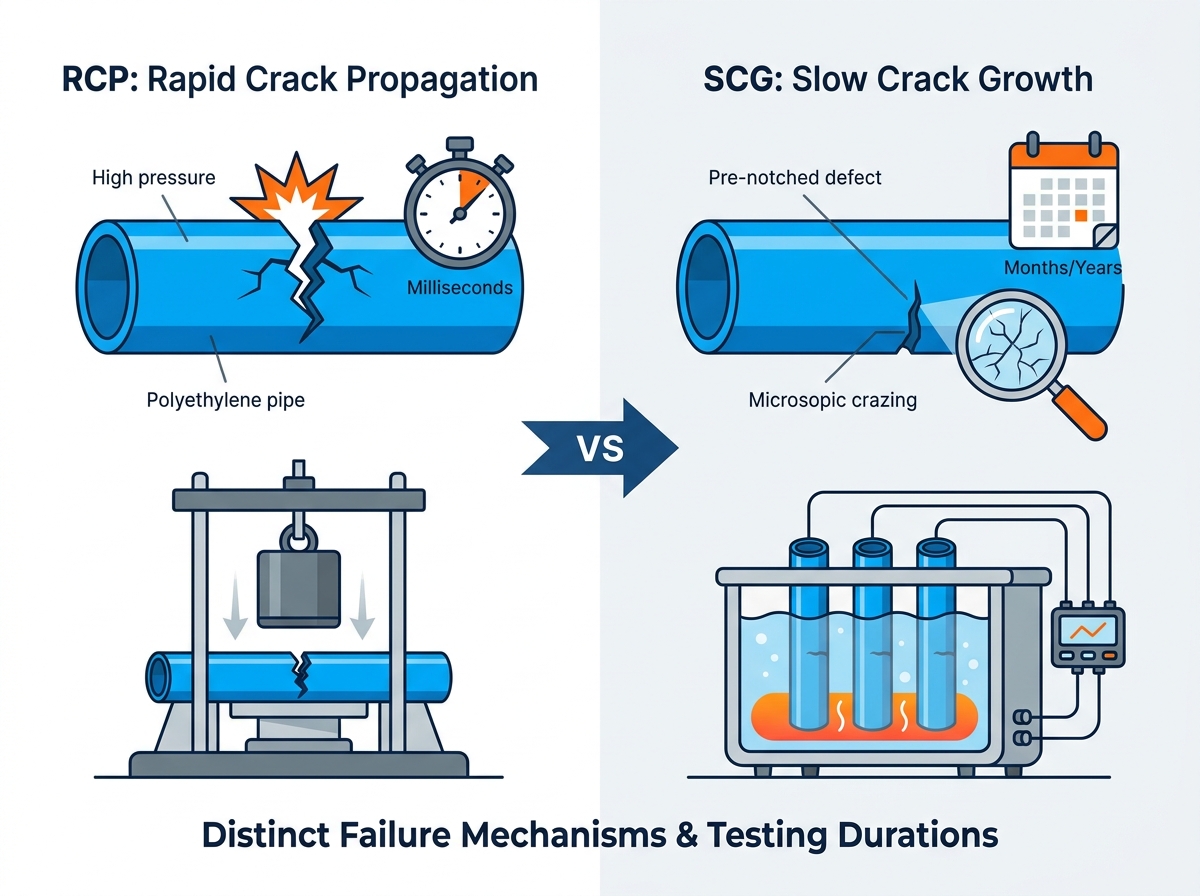
Polyethylene (PE) pipes face complex environmental and operational stresses over their 50-to-100-year lifecycle. Materials like PE100 and PE100-RC must withstand aggressive underground conditions without faltering. Failing to accurately predict pipe endurance leads to catastrophic infrastructure breaches. It invites heavy regulatory penalties and ruins manufacturer credibility. Engineers need reliable ways to forecast long-term survivability and immediate structural limits. We find the solution by distinguishing between macro-level immediate failures (RCP) and micro-level long-term degradation (SCG). Testing these distinct modes is required for strict material qualification and industry compliance. This article provides technical buyers, QA/QC directors, and compliance officers with a clear framework. You will understand exactly what these tests reveal. You will also learn how to evaluate the equipment or laboratory services needed to execute them successfully.
Key Takeaways
Distinct Failure Mechanisms: RCP measures sudden, high-speed brittle fractures driven by rapid decompression, while SCG evaluates long-term localized crack growth under sustained stress.
Critical Equipment Constraints: Accurate SCG testing relies heavily on precise sample preparation, requiring specialized tools like an SCG pipe notch milling machine to ensure valid baseline data.
Capital vs. Operational Expenditure: Deciding between procuring a rapid crack propagation tester for in-house use versus partnering with a PE pipe testing laboratory depends on testing frequency, R&D feedback needs, and ISO accreditation requirements.
Compliance Benchmarks: Both test methods require strict adherence to international standards (e.g., ISO 13477 for RCP, ISO 13479 for SCG) to ensure legal and operational viability.
Understanding the Failure Modes: The Physics of RCP and SCG
Understanding pipe failure requires looking at both immediate fracture mechanics and long-term material fatigue. PE pipes fail in two primary ways. Each mode presents unique physical characteristics and business risks.
Rapid Crack Propagation (RCP)
Rapid Crack Propagation happens in milliseconds. A sudden internal pressure spike or an external physical impact triggers it. Cold conditions often exacerbate this vulnerability. The pipe material becomes more brittle as temperatures drop. When RCP begins, a fracture moves faster than the depressurization wave of the fluid inside.
This dynamic results in long, continuous brittle fractures. These fractures can destroy extensive pipeline sections in seconds. The business impact is immediate. You face a catastrophic loss of containment. This poses severe safety hazards, especially in gas distribution networks where escaping gas can ignite.
Slow Crack Growth (SCG)
Slow Crack Growth takes months or even years to fully develop. Localized stress concentrations drive this mechanism. These stress points originate from rocks pressing against the buried pipe, poor installation practices, or surface scratches during transport.
The failure manifests as microscopic crazing. Micro-fibrils within the polymer stretch and eventually break. Over time, these micro-cracks merge. They slowly breach the entire pipe wall. The business impact includes gradual leaks. You will face costly maintenance operations, environmental contamination, and significant non-revenue water or gas losses.
Comparison Chart: Failure Mode Characteristics
Feature
Rapid Crack Propagation (RCP)
Slow Crack Growth (SCG)
Time to Failure
Milliseconds to seconds
Months to decades
Primary Trigger
Impact, sudden pressure spikes, cold temperatures
Localized stress concentrations, point loads, scratches
Physical Mechanism
High-speed brittle fracture
Microscopic crazing and fibril rupture
Business Impact
Catastrophic containment loss, major safety hazards
Gradual leaks, high maintenance costs, product loss
Engineers must simulate worst-case scenarios to certify pipe safety. The objective of RCP testing is highly specific. We must determine the critical pressure (Pc) and critical temperature (Tc). These are the thresholds where a moving crack will arrest rather than propagate further.
The S4 Test Framework (ISO 13477)
The industry relies on the Small-Scale Steady-State (S4) method under ISO 13477. Full-scale testing requires long lengths of pipe and massive test fields. It is prohibitively expensive and dangerous. The S4 test scales this down safely into a controlled laboratory setting.
The S4 method isolates internal pressure dynamics. It uses internal baffles fitted inside a short pipe sample. When the striker initiates a crack, these baffles prevent the internal gas from decompressing rapidly. This brilliant engineering trick mimics the behavior of a miles-long pipeline using only a short test specimen.
Evaluating Test Equipment
Procuring a reliable rapid crack propagation tester requires careful technical scrutiny. You cannot compromise on sensor accuracy or safety mechanisms.
Data Acquisition Speed: Crack velocities during an RCP event often exceed 300 meters per second. Sensor response times must capture data at microsecond intervals. Sluggish sensors will miss the exact moment of crack arrest.
Temperature Conditioning: Precision chillers are mandatory. They must maintain exact sub-zero testing environments. Thermal drift during the test invalidates the critical temperature (Tc) findings.
Safety and Containment: RCP tests involve violent bursts. Evaluate the blast-shielding construction. Automated pressure release mechanisms are non-negotiable to protect laboratory personnel from shrapnel and acoustic shock.
SCG Testing: Predicting Long-Term Survivability
While RCP focuses on sudden disaster, SCG testing looks at decades of slow wear. The primary objective is to measure the time-to-failure in hours. Technicians subject a pre-notched pipe to continuous hydrostatic pressure. They elevate the water temperature, typically to 80°C, to accelerate the aging process.
The Role of Sample Preparation
Standard compliance under ISO 13479 dictates exact notch depth and geometry. The notch simulates a severe surface scratch. The validity of the entire test rests on this single cut.
An industrial-grade SCG pipe notch milling machine is completely non-negotiable. Manual or substandard notching introduces unintended micro-stresses. A dull blade can melt the polymer slightly, changing its crystalline structure. These minor deviations act as false crack initiation sites. They prematurely rupture the sample and invalidate hundreds of hours of testing data. High-quality milling ensures uniform stress distribution along the notch root.
Alternative SCG Methods
Engineers also utilize material-level tests alongside whole-pipe ISO 13479 testing. These include the Pennsylvania Notch Test (PENT), Full Notch Creep Test (FNCT), and Notch Pipe Test (NPT).
Material-level tests are excellent for rapid resin batch release. They require smaller samples and confirm the raw polymer quality. However, final product qualification requires whole-pipe testing. Whole-pipe testing accounts for the extrusion process. Extrusion can introduce residual stresses that material-level tests simply cannot detect.
In-House Testing Equipment vs. Outsourced Laboratory Services
Companies face a significant business problem when scaling their quality control. They must balance the high capital expenditure of specialized machinery against the recurring costs and delays of third-party testing.
Building In-House Capabilities
Bringing testing in-house transforms your R&D process. You gain an immediate feedback loop. This is crucial when developing complex blends like PE100-RC. You achieve a much lower cost-per-test at high volumes. You also maintain absolute control over testing schedules, eliminating external wait times.
However, implementation carries risks. You face a high initial capital outlay for major equipment. You must enforce strict calibration maintenance. Furthermore, your facility must accommodate structural upgrades for blast containment and house high-capacity industrial chillers.
Partnering with an External Facility
Outsourcing to a dedicated PE pipe testing laboratory offers distinct advantages. You carry zero capital expenditure. You gain immediate access to independent ISO 17025 accredited reporting. Utility tenders and government contracts often mandate these independent reports. You also mitigate all equipment maintenance overhead.
The downsides involve workflow friction. You will experience slower turnaround times. Third-party labs often create bottlenecks during peak production cycles. You also lose the agility needed for fast, iterative product development.
Strategic Framework for Selecting Pipe Testing Infrastructure
Making the right infrastructure choice requires a systematic approach. Use this framework to evaluate your specific operational needs.
Assess Testing Volume and Frequency: Track your annual testing requirements. Determine the specific threshold where outsourcing costs exceed the amortized cost of purchasing and running an in-house SCG/RCP lab. High-volume manufacturers almost always benefit from internal labs.
Audit Equipment Vendor Compliance: Never take compliance for granted. Ensure equipment manufacturers guarantee strict conformity with ISO 13477, ISO 13479, ASTM F1473, and relevant local standards. Request their validation data.
Evaluate Software and Automation: Modern testers must streamline workflows. Look for automated pressure stepping. Real-time remote monitoring is essential for SCG tests that run for over 1000 hours. The software must generate unalterable audit trails to satisfy external compliance audits.
Lifecycle Support: Testing machines endure heavy use. Assess the vendor's Service Level Agreement (SLA). Confirm their turnaround time for calibration services. Verify spare parts availability and technical support accessibility in your region.
Conclusion
RCP and SCG tests isolate distinct, equally critical vulnerabilities in polyethylene piping systems. RCP identifies the threshold for sudden catastrophic failure, while SCG predicts decades of wear under sustained stress. The accuracy of your test data is only as reliable as your methodology and hardware. A perfectly calibrated notch milling setup and a structurally sound crack propagation testing unit form the backbone of a successful QC program.
We recommend auditing your current quality control bottlenecks immediately. Weigh the return on investment of upgrading your internal capabilities against the stability of securing a trusted third-party testing partner. Proactive investment in testing infrastructure protects your brand and secures long-term market compliance.
FAQ
Q: What is the typical test duration for an SCG test under ISO 13479?
A: The duration depends heavily on the specific PE grade and test conditions. Standard requirements often dictate 165 hours for basic compliance. However, modern high-resistance materials like PE100-RC frequently undergo extended testing exceeding 1000 hours to properly validate their long-term survivability.
Q: Why is the S4 method preferred over Full-Scale testing for RCP?
A: The S4 method offers massive cost, space, and safety advantages. It uses a short pipe section fitted with internal baffles to simulate the gas decompression of a long pipeline. Mathematical correlation reliably allows this small-scale S4 data to accurately predict Full-Scale pipeline behavior.
Q: How critical is the notching process in SCG testing?
A: It is absolutely vital. Minute deviations in notch geometry or depth can exponentially skew failure times. Poor cutting techniques introduce thermal damage and unintended micro-stresses. This emphasizes the strict necessity of using precision milling equipment rather than manual tools.
Q: When should a manufacturer mandate third-party lab verification?
A: Third-party verification is crucial during initial product certification. It is also required when resolving technical disputes with resin suppliers. Furthermore, most government infrastructure contracts and municipal utility tenders specifically mandate independent ISO 17025 accredited reports as a strict prerequisite.