Quality assurance bottlenecks and material qualification failures carry immense stakes in modern manufacturing environments. A single faulty batch can disrupt global supply chains, delay product launches, and cause severe financial losses. Selecting thermal testing equipment is no longer just about passing a one-off compliance check. It directly dictates your daily throughput efficiency, guarantees operator safety, and ensures data integrity across complex workflows. Facilities need robust systems to prove material performance reliably. This guide provides a pragmatic, evidence-based framework for evaluating and procuring testing equipment. We will explore how to align hardware capabilities with both your laboratory’s operational realities and strict international regulatory mandates. You will learn to identify essential machine specifications, assess heating medium trade-offs, and choose automation levels suited to your testing volume. By understanding these technical nuances, you can confidently upgrade your laboratory infrastructure.
Key Takeaways
Equipment selection should be dictated by your required testing volume, preferred heating medium (oil vs. oil-free), and necessary level of automation.
Compliance with ISO 306 and ASTM D1525 requires specific, verifiable tolerances in heating rates (50°C/h or 120°C/h) and precise load applications (10N or 50N).
Modern testers often combine HDT (Heat Deflection Temperature) and Vicat capabilities, offering a better ROI for diverse laboratories.
The Role of Accurate Hardware in Polymer Compound Testing
Proper execution of polymer compound testing requires absolute precision. Thermal gradient inaccuracies introduce severe financial and operational risks across the supply chain. Minor temperature deviations can trigger false batch rejections. Imagine rejecting tons of automotive-grade polycarbonate due to a 2°C sensor error. These failures delay time-to-market and harm your competitive edge. They also lead to non-compliant material certifications. Faulty data ruins supplier credibility quickly.
Many laboratories now procure combined HDT and Vicat machines to maximize utility. The Vicat Softening Temperature (VST) and Heat Deflection Temperature (HDT) measure different material responses. VST tracks localized needle penetration. It reveals when a polymer loses its surface form stability. HDT measures physical deflection under continuous bending stress. However, both tests share the same underlying thermal bath and sensor infrastructure. Buying a combined system creates excellent operational synergy.
A successful equipment procurement strategy hinges on several core criteria. You must prioritize highly repeatable data generation across multiple testing shifts. Systems should require minimal operator intervention during test cycles. They also need seamless integration into your existing Laboratory Information Management Systems (LIMS). Direct connectivity prevents transcription errors. It speeds up reporting and ensures data integrity. A common mistake is ignoring LIMS compatibility during the procurement phase. You must secure this feature early.
Aligning Machine Specs with Accreditations and Standards
Global testing protocols dictate rigid hardware requirements. Your equipment must physically support the nuances of both ISO 306 and ASTM D1525. Satisfying third-party accreditations and standards means eliminating hardware shortcuts. Auditors look for physical proof of compliance during site visits.
The machine must deliver standardized loads precisely. Tests demand either 10 N or 50 N applications. Applying these forces requires calibrated dead weights or pneumatic systems. Heating rates must remain perfectly linear throughout the cycle. Standards dictate exact climbs of 50 °C/h or 120 °C/h. The penetration depth requirement is similarly strict. The system must record the bath temperature the exact moment a needle achieves 1 mm of penetration.
You need high-precision LVDT (Linear Variable Differential Transformer) displacement sensors. These sensors capture micrometric material changes without mechanical lag. Inferior sensors miss the precise 1 mm milestone due to internal friction. This friction skews your final VST result.
Software also plays a critical role in audit readiness. The operating program must handle traceable reporting effortlessly. It should log all raw data automatically. Auditors look for secure, unalterable test records to verify compliance. Best practices involve setting up automated data backups to secure servers.
Key Evaluation Criteria for a Vicat Softening Point Tester
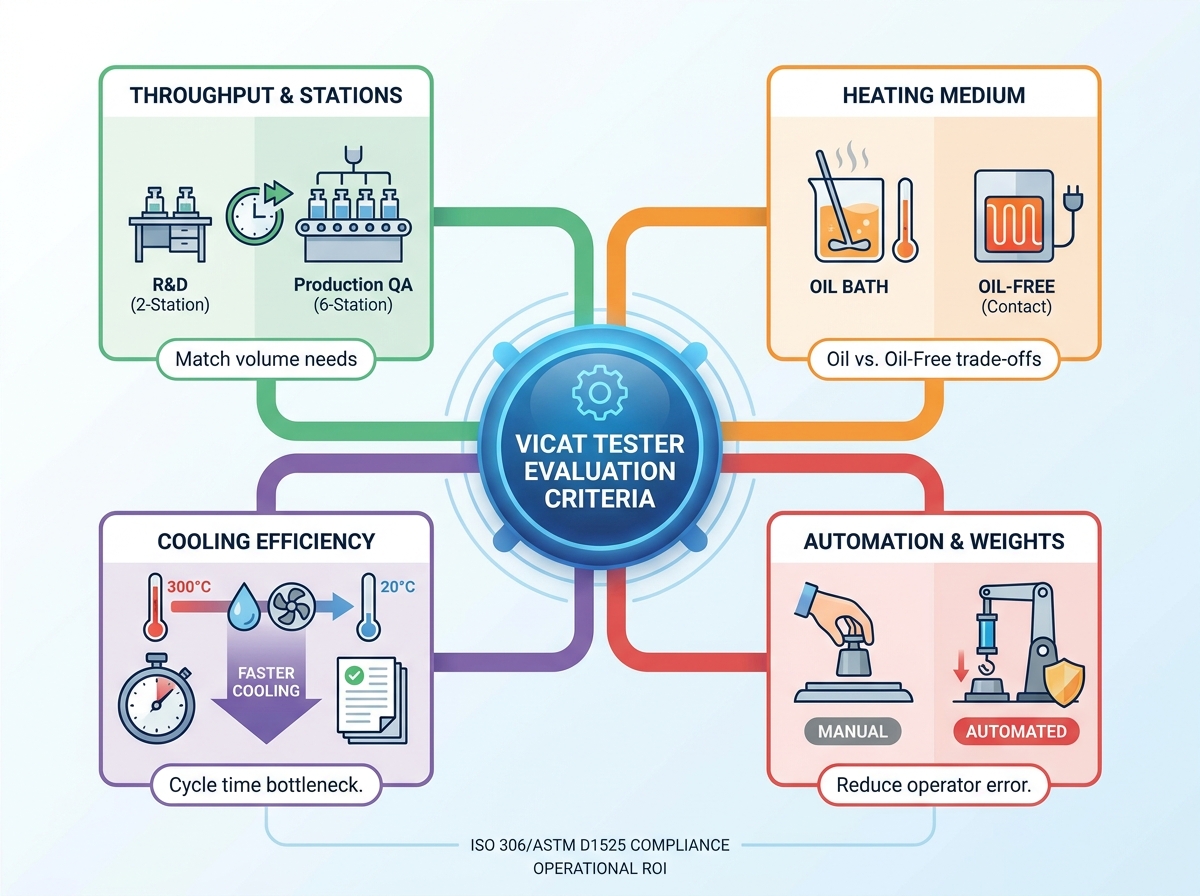
Choosing a Vicat softening point tester requires analyzing your daily operational limits. Testing stations directly impact laboratory throughput. A 2-station setup suits basic R&D environments testing experimental blends. A 6-station configuration serves high-volume production QA perfectly. You must balance the physical footprint against testing capacity. A larger machine consumes valuable bench space.
Heating medium capabilities define testing efficiency. Silicon oil baths remain the industry standard worldwide. They offer excellent thermal stability across long test runs. However, they require active, engineered stirring mechanisms to ensure uniform temperature distribution. Standard impellers often fail to mix high-viscosity oil evenly. Stagnant oil creates localized hot spots, ruining the linear heating curve. Oil-free contact heating represents a rapidly rising trend in modern testing. These advanced systems use conductive copper or aluminum blocks. They create significantly cleaner workspaces by eliminating fluid spills.
Cooling systems often create the biggest testing bottleneck in busy QA environments. After reaching peak temperatures near 300°C, the machine must safely return to its starting temperature before a new test begins. Relying on ambient air cooling is completely impractical. Faster cooling directly equals higher daily test throughput. Evaluate external closed-loop chillers against standard tap-water cooling options. Tap water temperature fluctuates seasonally, causing inconsistent cooling cycle times. Dedicated chillers provide consistent, rapid temperature drops regardless of ambient conditions. They also prevent mineral scale buildup inside the machine's cooling coils.
Automation significantly impacts repeatability. Assess manual weight application against motorized load application. Automated lowering mechanisms reduce operator fatigue drastically. They also prevent physical setup errors. Hand-placing weights often disturbs the initial specimen position. Motorized systems lower weights gently and precisely.
Testing Station Configuration Overview
Configuration
Ideal Environment
Throughput Capability
Footprint Requirement
2-Station Setup
R&D, Low Volume QA
Low (1-4 tests daily)
Minimal
4-Station Setup
Mid-Level Production
Medium (5-10 tests daily)
Moderate
6-Station Setup
High-Volume Manufacturing
High (10+ tests daily)
Significant
Implementation Realities and Operational Risks
Laboratory managers face distinct implementation challenges daily. Thermal medium degradation remains a constant issue in high-volume labs. High-grade silicone oil ages over repeated heating cycles. Operating at temperatures up to 300°C breaks down the fluid molecularly. You must account for the logistical demands of replacing this oil safely. High temperatures also necessitate robust fume extraction systems. Proper ventilation removes harmful silicon vapors. Exposing operators to hot fumes violates standard safety protocols.
Operator safety stands as a non-negotiable metric during equipment evaluation. Handling specimens near hot fluids presents severe burn hazards. You must demand automated safety shields that lock during active heating phases. Independent over-temperature shutoffs prevent catastrophic overheating events if the primary controller fails. Secure specimen loading racks protect hands from hot oil splashes during sample retrieval. A common mistake is buying open-bath systems. This severely compromises lab safety and violates corporate HSE (Health, Safety, and Environment) policies.
Complex proprietary software creates significant usability risks. Outdated interfaces frustrate operators and slow down testing. You need intuitive software requiring minimal training. Modern interfaces plot temperature versus penetration curves in real-time. They automatically calculate the VST without requiring manual extrapolation. This reduces human error and speeds up data delivery dramatically. The software should allow custom user profiles to lock specific testing parameters securely.
How to Shortlist ISO 306 Vicat Testing Equipment Vendors
Evaluating manufacturers involves more than reading marketing brochures. Finding reliable ISO 306 Vicat testing equipment requires a strict shortlisting process. You need a partner, not just a supplier.
Start by verifying calibration and support capabilities. Prioritize vendors offering ISO 17025 accredited calibration services. You also need accessible local field-service engineers. Remote phone support cannot fix mechanical breakdowns or replace failed sensors. An engineer must visit your facility quickly.
Always demand a proof of concept before signing a purchase order. Request a sample test using your specific polymer blends. This verifies heating linearity and sensor accuracy before purchase. It guarantees the machine handles your exact materials. Ask the vendor to provide the raw test data files for your review.
Take proactive next steps during your initial vendor consultation. Evaluating their technical transparency reveals their true expertise. Use structured questions to expose weak engineering.
Vendor Assessment Checklist
Ask for historical data on cooling cycle times under heavy usage.
Request documentation proving heating rate uniformity across all testing stations.
Verify the integration capabilities of their control software with your current LIMS.
Confirm the local availability of replacement LVDT sensors and heating elements.
Thermal Testing Standards Reference Guide
Standard Designation
Primary Scope
Key Parameter
ISO 306
Thermoplastics Vicat Softening
1 mm penetration depth
ASTM D1525
Vicat Softening Temperature
10 N or 50 N load
ISO 75
Heat Deflection Temperature
Specified flexural stress
Conclusion
Choosing the right equipment bridges the gap between regulatory compliance and operational profitability. Proper hardware safeguards your production lines from material failures. Evaluating the cooling system and heating medium is just as critical as analyzing sensor accuracy. These components dictate your real-world daily throughput.
Take control of your quality assurance workflow today. Action-oriented next steps include:
Audit your current daily testing volume to determine the exact necessary station count.
Evaluate your lab ventilation capabilities before choosing an oil-based heating system.
Consult with a technical specialist to scope the ideal automation level for your team.
FAQ
Q: Can the same machine perform both ISO 306 (Vicat) and ISO 75 (HDT) tests?
A: Yes. Most modern thermal testers feature modular designs. Operators can easily swap penetration needles for deflection testing heads. They use the same thermal bath and sensor framework. This combined functionality maximizes your laboratory floor space and hardware investment.
Q: What is the practical difference between oil-based and oil-free Vicat testers?
A: Oil-based testers provide excellent thermal uniformity but require fume management and routine oil replacement. Oil-free systems use conductive heating blocks. They eliminate messy cleanups and consumable fluid logistics. However, oil-free machines generally carry a higher initial purchase price.
Q: How often does a Vicat softening point tester need to be calibrated?
A: Industry standards require annual calibration. Technicians must verify the accuracy of both displacement sensors and temperature probes. This yearly schedule maintains strict compliance with ISO and ASTM quality management systems.
Q: Why is my Vicat tester failing to maintain a linear heating rate?
A: Non-linear heating usually points to degraded thermal oil. It can also indicate a failing heating element. Inadequate stirring mechanisms cause localized hot spots in the bath. Routine maintenance of the thermal medium prevents these costly temperature fluctuations.