Polymer manufacturing faces a persistent quality control bottleneck when evaluating polyethylene (PE) compounds. Discrepant test results frequently delay production. They also complicate critical batch approvals. Manufacturers often struggle to accurately measure compound additives.
The core issue stems from misinterpreting inorganic filler residue as a functional UV-stabilizing additive. Engineers sometimes confuse standard ash with carbon black. This dangerous substitution leads to premature material failure. It causes rejected batches and severe standard non-compliance. Polyethylene pipes and geomembranes rely heavily on exact additive formulations. Without them, structural integrity degrades rapidly under environmental stress.
We will dismantle the methodological differences between these two crucial metrics. You will discover the relevant testing standards governing both processes. We will also provide a clear evaluation framework. This guide will help you select the correct analytical instrumentation for your laboratory.
Key Takeaways
Carbon black testing isolates the specific carbon additive via inert gas pyrolysis; ash content testing measures total remaining inorganic residue after full oxygen combustion.
Substituting an ash content test for a carbon black test in loaded PE compounds will artificially inflate readings due to the presence of silica, calcium carbonate, or other inorganic fillers.
Compliance with pipeline and structural PE standards (e.g., PE100+ requirements) dictates strict adherence to specific methods like ASTM D1603, requiring purpose-built equipment with precise atmospheric controls.
Selecting between a dedicated carbon black content tester and a generalized ash content analyzer depends heavily on your required throughput, filler complexity, and audit-trail needs.
The Business Impact of Confusing Ash and Carbon Black in Quality Control
The Role of Carbon Black in PE Compounds
Polyethylene is inherently vulnerable to ultraviolet radiation. UV photons break molecular chains within the polymer matrix. This degradation causes severe embrittlement. Manufacturers add carbon black to absorb these damaging UV rays. It acts as a powerful radical scavenger.
Carbon black ensures long-term structural integrity. It maintains thermal stability across decades of use. Demanding applications require precise concentrations. Polyethylene pipes transporting pressurized water need exact carbon dispersion. Geomembranes lining hazardous waste sites also depend on this critical additive. Without adequate protection, these infrastructure materials fail.
The Cost of False Positives
Treating general residue as pure carbon black creates false positives. High "ash" readings often get misinterpreted as adequate UV protection. You might see a 2.5% residue reading and approve the batch. However, that residue might contain only 1% actual carbon black.
The remaining 1.5% could be calcium carbonate or talc. These inorganic fillers offer zero UV resistance. The resulting product is structurally compromised. Once installed outdoors, the polyethylene degrades under sunlight. The material cracks, leaks, or ruptures prematurely. Field failures lead to massive liability claims and damaged brand reputation. Recalling defective PE pipes costs exponentially more than proper laboratory testing.
Compliance Thresholds
Failure to differentiate these metrics directly violates strict industry benchmarks. ISO and ASTM establish rigid thresholds for commercial-grade polyethylene. For instance, PE100+ standards demand a very specific carbon black concentration.
Typically, regulatory bodies require between 2% and 2.5% carbon black by mass. They also specify acceptable dispersion grades. Relying on an incorrect test method invalidates your compliance certificates. Auditors will reject batches if your testing methodology fails to isolate true carbon content. You must utilize the correct atmospheric controls to meet these legal requirements.
Methodological Breakdown: Pyrolysis vs. Combustion
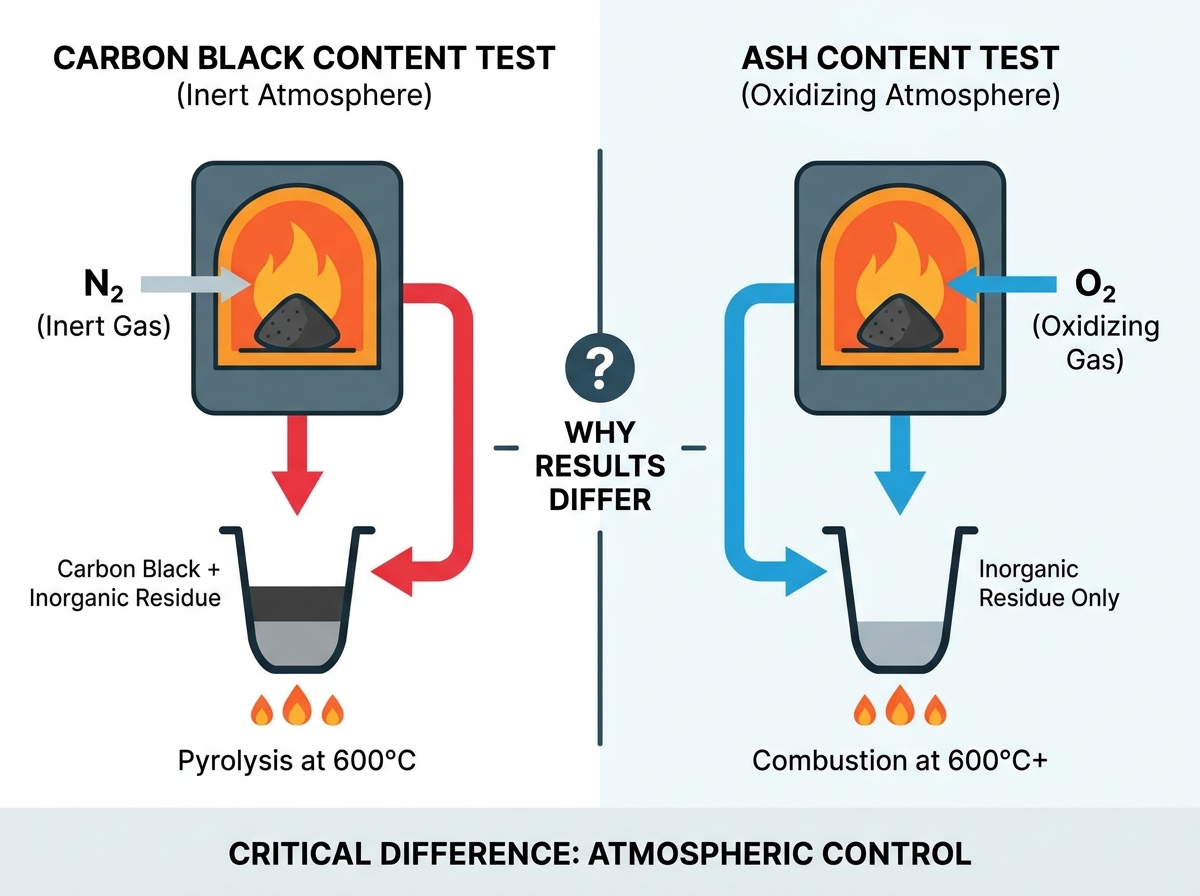
Understanding the exact chemical processes prevents costly testing errors. The distinction relies entirely on atmospheric control during heating.
Carbon Black Content Testing (Inert Atmosphere)
This method protects the carbon while destroying the surrounding polymer.
Mechanism: The process relies on pyrolysis. Pyrolysis is thermal degradation in a completely oxygen-free environment. The system purges the heating chamber with high-purity nitrogen gas.
Outcome: The intense heat vaporizes the polymer matrix. Because there is no oxygen, the carbon black cannot burn. It remains intact inside the crucible.
Key Standards: Global testing protocols dictate this method. ASTM D1603 and ISO 6964 are the primary standards. They specify exact temperature ramps and nitrogen flow rates.
Ash Content Testing (Oxidizing Atmosphere)
This method destroys everything organic, leaving only inorganic material behind.
Mechanism: The process relies on complete combustion. It occurs in an oxygen-rich environment. Laboratories typically use a heavy-duty muffle furnace for this task.
Outcome: Oxygen reacts with both the polymer matrix and the carbon black. Both materials oxidize and turn into gas. The test leaves only non-combustible inorganic fillers. These include glass fibers, talc, silica, or calcium carbonate.
Key Standards: ASTM D5630 and ISO 3451 govern this procedure. They focus on determining the total inorganic loading of a polymer.
The Overlap Dilemma
Testing "filled" PE compounds presents a unique challenge. Many modern polymers contain both carbon black and inorganic fillers. A single test cannot yield the full picture.
If you run a standard pyrolysis test, the residue contains both carbon black and ash. The nitrogen prevents the carbon from burning. The inorganic ash survives the heat regardless. To isolate the true carbon content, you must perform sequential testing. First, you record the weight after the nitrogen pyrolysis stage. Then, you introduce oxygen into the chamber. The oxygen burns away the carbon black. You weigh the final remaining ash. Subtracting the final ash weight from the first residue weight gives you the exact carbon black percentage.
Equipment Evaluation: Carbon Black Content Tester vs. Ash Content Analyzer
Choosing the right hardware defines your laboratory's testing capabilities. Different instruments serve distinct analytical purposes.
Evaluating the Carbon Black Content Tester
A dedicated carbon black content tester is engineered for highly sensitive atmospheric control. Standard furnaces simply cannot achieve this precision.
Core Capabilities: These instruments must feature automated nitrogen purge systems. They utilize specialized quartz tube furnaces rather than open brick chambers. The quartz tube ensures an airtight environment. Precise heating profiles prevent premature oxidation. The system flushes ambient air out completely before the temperature rises.
Best For: This equipment is mandatory for labs focused on polyolefins. It is the gold standard for PE piping manufacturers. Wire and cable insulation producers also rely on it for compliance testing. If your primary goal is verifying UV stabilizer levels, this is the required tool.
Evaluating the Ash Content Analyzer (Muffle Furnace Technique)
A generalized ash content analyzer focuses on brute thermal force and oxygen exposure.
Core Capabilities: These systems provide high-temperature continuous heating. They operate in ambient air or enriched oxygen atmospheres. They are built for total organic burnout. The internal chambers use robust refractory bricks. They do not require airtight seals or gas flow meters.
Best For: These analyzers excel at general polymer characterization. They easily determine raw filler ratios in composite materials. They are perfect for broad material composition checks where isolating specific carbon types is unnecessary.
Hybrid / Programmable Systems
Advanced laboratories often encounter highly complex composite materials. Modern manufacturers offer hybrid instruments to solve the overlap dilemma. These programmable systems automate atmospheric switching mid-test.
The unit starts by flooding the chamber with nitrogen. It runs the full pyrolysis cycle to degrade the polymer. Once it records the initial weight, the software takes over. It automatically shuts off the nitrogen valve. It then opens an oxygen supply line. The furnace temperature ramps up again to initiate combustion. This single-run approach calculates both metrics sequentially. It drastically reduces technician handling time and minimizes sample contamination risks.
Comparison of Analytical Equipment Capabilities
Feature/Capability
Dedicated Carbon Black Tester
Standard Ash Analyzer (Muffle Furnace)
Atmosphere Control
Strictly airtight inert gas (Nitrogen)
Open to ambient air / Oxygen
Heating Chamber
Sealed Quartz Tube
Refractory Brick Chamber
Target Material
Carbon Black Additives
Total Inorganic Fillers (Glass, Talc)
Primary Standard
ASTM D1603, ISO 6964
ASTM D5630, ISO 3451
Polymer Destruction
Pyrolysis (Thermal Degradation)
Combustion (Oxidation)
Implementation Realities and Testing Blind Spots
Even the best equipment requires rigorous operational discipline. Laboratories frequently encounter testing blind spots that skew results. You must proactively manage these environmental and procedural variables.
Gas Flow Calibration Risks
Atmospheric integrity is the most critical factor in pyrolysis. Improper nitrogen flow rates introduce trace amounts of oxygen into the chamber. Even a microscopic leak ruins the test.
If the flow rate is too low, ambient air creeps backward into the exhaust port. Trace oxygen causes partial carbon burn-off. This leads to falsely low carbon black readings. Conversely, if the flow rate is too high, it cools the sample unevenly. It can also physically blow lighter carbon particles out of the combustion boat. You must calibrate gas flow controllers regularly to maintain exact procedural parameters.
Crucible Contamination
Weight measurements in these tests occur at the micro-gram level. Cleanliness directly impacts data accuracy. Residual inorganic ash from previous tests severely affects new measurements.
Technicians often reuse combustion boats. If they do not clean them thoroughly, microscopic silica or talc particles remain. When you weigh the new sample, this old residue artificially inflates the reading.
Best Practices for Crucible Management:
Pre-bake all crucibles at 800°C for one hour before use.
Store cleaned crucibles in a desiccator to prevent moisture absorption.
Never handle combustion boats with bare hands; always use specialized tongs.
Assign specific crucibles to specific polymer types to prevent cross-contamination.
Sample Prep Variability
How you prepare the polyethylene sample influences the test outcome. Sample geometry and weight consistency affect pyrolysis efficiency.
If you place a single, massive chunk of polymer into the crucible, it heats unevenly. The outer layer degrades quickly, while the core remains insulated. This traps volatile gases inside the matrix. To ensure test repeatability, technicians must cut samples into uniform, small fragments. Thin shavings or tiny pellets expose maximum surface area to the heat. Consistent sample weight across different batches also standardizes the degradation timeline. We recommend keeping sample masses strictly within the standard's suggested limits.
Shortlisting Criteria for Decision Makers
Procuring new laboratory hardware requires careful consideration of operational workflows. Focus on systems that guarantee compliance and reduce human error.
Standard-Natively
Laboratory managers should never have to guess temperature ramps. An ideal instrument natively supports programmed heating profiles out of the box.
Check if the device includes pre-configured settings for ASTM D1603 and ISO 6964. The software should automatically handle the specific temperature holds required by these standards. It should dictate exactly when the nitrogen purge begins and ends. Native standard support drastically reduces training time for new lab technicians. It eliminates manual programming errors that compromise batch testing.
Data Integrity & Automation
Modern quality control demands strict traceability. Manual data transcription is a major source of laboratory errors.
Evaluate the need for integrated microbalances. Systems that weigh the sample inside the furnace eliminate handling mistakes. Automated cooling blocks are also highly valuable. They rapidly bring the sample down to room temperature within a controlled desiccated environment.
Furthermore, consider your compliance reporting needs. ISO 17025 accredited laboratories require unalterable digital audit trails. The equipment's software must log every temperature fluctuation and gas flow variation. This permanent record proves to auditors that the test environment remained perfectly stable. Secure data export features ensure your final quality certificates are completely reliable.
Conclusion
Accurate PE compound evaluation is not just a matter of temperature. It relies entirely on precise atmospheric control. Pyrolysis isolates carbon black, while combustion identifies total inorganic fillers. You cannot manage what you cannot accurately measure.
Trying to shoehorn a basic ash testing protocol into a carbon black compliance requirement is dangerous. It introduces unacceptable commercial risk and inevitable field failures. Misinterpreting analytical data leads directly to structurally compromised infrastructure.
Review your current compound formulations immediately. Determine whether you process heavily filled or unfilled polyolefins. Use this knowledge to finalize your equipment specifications. If your materials demand strict UV resistance validation, book a consultation or demo for purpose-built inert-atmosphere testing hardware.
FAQ
Q: Can I use a standard ash content analyzer to test for carbon black?
A: No. Standard ash analyzers typically lack the airtight nitrogen purge systems required for this specific analysis. Without an inert atmosphere, the carbon black oxidizes and burns away during the test, rendering the results completely inaccurate for UV stabilizer validation.
Q: Why does my carbon black content test show higher percentages than the formulation sheet?
A: This usually indicates the presence of other inorganic fillers like silica or calcium carbonate. These fillers survive the nitrogen pyrolysis phase. An additional combustion step is required in an oxygen atmosphere to subtract this ash weight from the final calculation.
Q: What is the standard temperature for carbon black testing in PE?
A: Under ASTM D1603, the primary pyrolysis stage in a nitrogen atmosphere is typically conducted at 600°C for polyethylene compounds. The exact heating ramp and duration depend on the specific material grade being tested.
Q: How often should testing equipment be calibrated?
A: Flow meters, temperature probes, and integrated analytical balances should undergo certified calibration annually. You should calibrate them more frequently depending on your daily lab throughput, baseline drift observations, and specific ISO audit schedules.